The Weatherdragon Chronicles · Season One
Episode 2: Ember Season
It did not dance. It bowed.
The day had been dry from sunrise, a heat that did not rage but endured. It lay over the prairie in a thin shimmering weight, bleaching the distance and drawing every green thing inward. The small creek had shrunk from its spring edges. Dust stuck to the ruts in the lane and settled in the joints of the fence posts. Beyond the yard, the wheat stood ripe and waiting, each head full and pale gold. Heavy now, the field moved with slower dignity than it had earlier in the summer.
Below, near the west fence, a burn pile sent up a steady column of smoke.
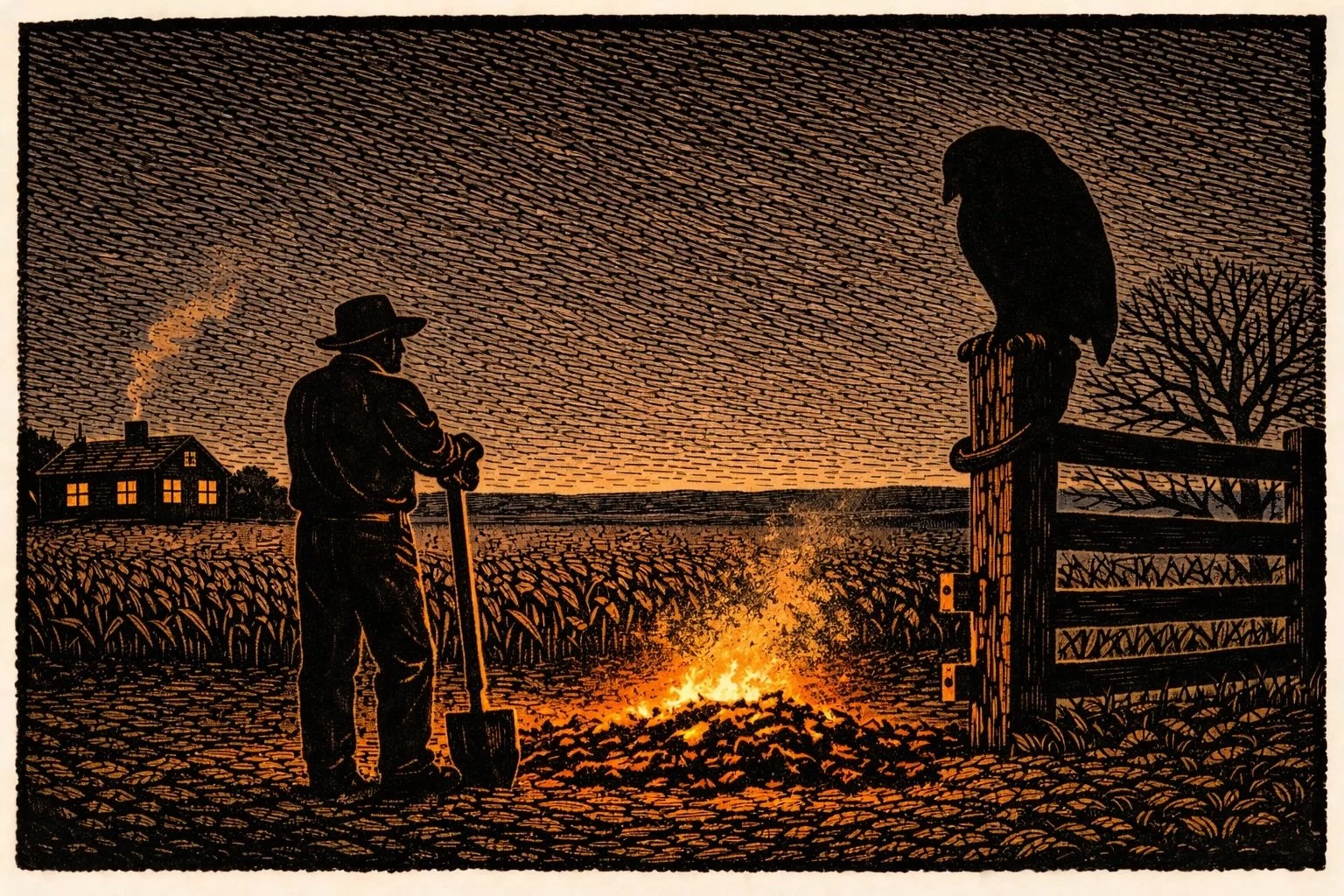
The farmer stood by the burn pile with a shovel in both hands. He had built it from windfallen limbs, split brush, old sunflower stalks, and the ragged remains of a fence corner he had replaced two days before. The fire was no wild thing. He had fashioned it carefully, ringed it with bare earth, and fed it in turns. What burned now were mostly coals and the occasional tongue of orange flame lifting through the gray. Smoke rose in a blue-white line, dragging east under the evening wind.
He shifted one boot heel against the dirt and nudged a caving edge of ash back toward the center.
His work shirt clung darkly at the spine. His hat brim had taken on the low red light of sunset, and his forearms were covered with soot to the wrist. He had been out since morning and would likely still be moving at dusk, though the day had already crossed into that quieter hour when labour loosens, and a man begins to look more than he does.
Evenfall watched her children in the red-gold drop of evening as they drifted above the farmyard smoke.
Above the smoke column, Flurry flew through the warm air, spiralling downward and shooting upward again.
He was bright with the evening, his pale scales mirroring firelight one instant and copper sunset the next. He seemed made from two kinds of gleam at once. He never entered a current without wanting to turn it. He never passed a shift of temperature without trying it against his wings. Smoke especially delighted him. It climbed one way, then another. It coiled, wavered, broke apart, and gathered again. It was weather pretending to be a ribbon.
Chinook did not share his delight.
She flew low and steady beside the drifting plume, each wingbeat catching the updraft where heat lifted, then dipping methodically into the cooler currents folding in from the wheat field. Her ease was not laziness, but knowledge gained from years aloft. She angled one wing slightly, adjusting to every slight change in the air’s direction. Now and then, she looked at the burn pile, at the farmer beside it, and at the strip of dirt separating the yard from the first edge of wheat. Her stare returned again and again to that line.
Above them, Evenfall rode the highest, circling with slow, deliberate beats. Her broad wings were dark against a sky turning from brass to violet. She did not descend at once but let the scene settle, observing from above. The smoke climbed. The heat thinned. The prairie cooled almost imperceptibly. The farmer lifted his shovel and turned another collapse of embers inward. Her children moved below her, one studying, one playing.
Flurry plunged straight through the column of smoke again, tucking his wings and shooting through it headfirst. He burst out the far side, wings unfurling quickly as he spun, spilling ash, smoke and laughter into the air.
“Flurry,” Chinook called.
“I know where I am.”
“That is not what I meant.”
He shot upward, coughed once for effect, and rolled so the underside of one wing flashed in the sunset. “It tastes terrible.”
“Then stop. It looks better than it tastes.”
Chinook’s mouth quivered. “That, at least, I believe.”
He hovered before her with quick, excited wingbeats. “Look how it rises. It almost wants to be something.”
“It is something.”
He cast a glance downward. “It is only ash.”
“Heat,” Evenfall intoned from above. “Breath. Dry wood returning itself to the world.”
Flurry tipped his head back to look at her. “You make everything sound older than it is.”
“That is because it usually is.”
He made a face at that, then dropped again, circling lower this time.
The farmer saw him.
Not cleanly, not in the full detail one sees a hawk or a horse, but well enough. A pale shape moved where no bird ought to be, with too much intention for drifting ash and too much grace for chance. The longer he knew the dragons, the less he mistook them for anything else. His eye had learned their scale by how the air answered them.
No ordinary wingstroke altered a smoke column from top to base.
No hawk made firelight waver without touching the flames.
No weather vane of chance turned a thoughtful burn pile.
He leaned a little more of his weight onto the shovel and watched from beneath his brim.
He knew the pale one now. Quick, careless, delighted by his own speed. The one who treated the world as if it had been set out only for him to try with his claws and breath.
The farmer had known such boys in town.
Most grew out of it.
Most.
He slid the shovel blade under a blackened branch and levered it inward, burying its spark-tipped end beneath the ash. The fire breathed up around the blade, then settled. He had burned brush all his life. He knew how far a live ember could travel on a mean wind. He knew what dry grass would do with a coal no bigger than a fingernail. He knew too well what it meant to stand in a field after flame had had its say.
That knowledge sharpened him now more than the soot or heat.
The smoke drifted east.
So did the wheat.
Beyond the yard, the field stood waiting at the edge of danger with that false innocence dry things always carried.
Full heads. Brittle stems. Dust between the rows.
All the beauty of harvest.
All the appetite for fire.
Flurry swooped lower.
“Stay clear of the pile,” Chinook warned, not yet stern, but close.
He tipped one wing and skimmed the smoke sideways. “I am not in it. I am beside it.”
“The air is still part of it.”
“You sound like Evenfall,” he said.
“Because it sounds like something true.”
He ignored that.
Evenfall still had not descended. The sky around her had become darker until evening gathered under her wings. She tucked her talons below her chest and closed her eyes for a moment, feeling the air change on her scales as she watched Flurry in the clearing below. She watched Flurry with the patience of one who saw that warning and experience were not rivals, but stages.
Below, the farmer shifted position and planted his boots wider apart.
He no longer simply watched dragons.
He had begun, cautiously, to read them as he read weather signs in mare behaviour, cloud edges, the smell of far rain, or dawn frost’s hardness. The quick pale one circling smoke meant trouble. The warm, steady one beside him meant trouble not yet beyond mending. The dark broad one above meant judgment, patience, and the possibility, if things turned, of great restraint.
An ember crackled within the pile.
He looked down.
Then back up.
Flurry flew through the smoke once more, much lower than before. This time, his wingtip clipped the heated air above the coals. The plume split around him, then rushed together behind. The change was small. Had the farmer not already watched with all his attention, he might have missed it. But a burn pile is a creature of appetite and breath. The least interference alters how it feeds.
A bright coal at the edge of the ash bed burned more brightly.
The next wingbeat did it.
Flurry came up sharply, delighted by the sudden kick of warm air under him. That downward gust struck the loose edge of the pile, lifted a single live ember from the ash shelf, and sent it out spinning.
The bright ember was no bigger than the farmer’s little finger.
It did not look like much.
That was how such things always began.
He saw it at once, a red bead in the dimming light, too bright to be dust, too quick to be ordinary ash. It landed on bare dirt first, bounced, shed a tiny gold fan of sparks, then skipped again toward the yard’s dry edge, where the dirt thinned into cheatgrass and broken straw.
The farmer acted before he shouted.
His shovel came up in one hand as he ran.
Above him, Chinook’s head whipped around.
Flurry turned at the sound of the farmer’s voice and saw the ember racing away from the pile.
All delight left him.
“Oh, no.”
He dropped out of the air so hard he nearly stalled.
The ember hit a tuft of dried grass. It caught for a breath, brightened, then hopped free again as though alive. It moved not of its own will but by momentum and luck, the worst allies fire could have.
Another yard and it would reach the weedy margin.
Beyond that, the strip of stubble. Beyond that, wheat.
Flurry landed in a scramble ahead of the farmer, claws scratching furrows in the dust. “I will put it out.”
“Flurry,” Chinook shouted.
But panic had already taken him.
He sucked in breath and blew.
He meant to blow it out. To flatten the glow. To drive cool air against heat and break its hold.
Instead, because he was frightened and young, and stronger than he knew, his breath struck the ember like a hammer.
The spark shot forward in a red arc, skipped over the bare strip, and landed twice as near the field as before, radiating with fresh power.
For one dreadful instant, it disappeared in the ground clutter.
The farmer swore under his breath and ran harder.
Flurry stared after the vanished glow. “No.”
Chinook snapped her wings shut and folded them tightly, dropping swiftly from her flight position toward the ground.
Evenfall shifted her wings, angled her body, and finally descended from her high vantage point, moving down toward the others.
The farmer reached the place where the ember should have been and slashed his shovel through the dry edge grass. Dust rose. A puff of bitter smoke. No flame yet, thank God, not yet, but there, in the thin mat of straw and field chaff, a speck of orange was breathing itself wider.
He brought the shovel down flat to smother it, but before the metal touched ground, the ember skipped again, urged by the very rush of air made by his blow. It shot away from the blade and toward the field, shedding a black trail of smoke.
The farmer checked himself, his heart racing. He had panicked.
Too hard, and he would scatter it. Too slow and it would take.
He heard wings.
Not Flurry now. Chinook.
She came low over the yard, moving quickly but with the kind of focus that makes speed look clean.
Her eyes fixed not on the field, not on her brother, not even on the farmer, but on the ember itself. She saw where it was and, more importantly, how it was moving: driven by panic gust, skipping from bare patch to brittle patch, turning unpredictably where heat shimmer met cooling evening air.
“Do not blow at it,” Evenfall said, her intonation leaving no room for argument. This time, the command was for both younger dragons, the authority in her speech as natural as the weather.
Flurry came down hard, shame and fear making his whole body rigid. “I was only trying—”
“I know what you were trying.”
The farmer, crouched with shovel ready, would have given much at that very moment to hear those words spoken aloud in a human tongue he could plainly understand. As it was, they came to him in the shape of the air and in a dim sense of meaning, half hearing and half feeling. Over the weeks he had known the dragons, this had happened before: not language exactly, but something in the weather around them carrying intention straight into him. It did not feel stolen. It felt granted, like a privilege.
The ember flared once in a tuft of field-edge straw.
Chinook drew a breath.
Unlike Flurry’s, hers came low and deep, amassing not force alone but direction. The wheat nearest the field edge bent toward her. Dust lifted in a thin line along the dirt strip. The ember brightened as if deciding whether to leap again.
Then Chinook exhaled.
Her breath did not strike the spark head-on. It curved around it.
The farmer saw it as plainly as he had ever seen anything in the strange weather the dragons made, a stream of warm controlled air catching the ember’s far side and guiding rather than hurling it. The spark rolled. Not out toward the wheat, but sideways, then inward in a tight glowing arc. A little comet of fire, no larger than a walnut’s worth of danger, turned by sheer precision.
It hopped across the dirt. Skipped once over a blackened stick and then glowed at the rim of the ash bed.
Flurry held himself frozen, as if even his fear might disturb it.
Chinook breathed again, gentler still.
The ember slid back into the heart of the burn pile and sank below a settling blush of red coals.
✱
For a moment, no one moved.
The farmer remained bent forward with one hand on his shovel shaft, listening for the hateful quick crackle that would mean fire had taken elsewhere. He heard only the pop of the pile, the tick of cooling metal from the shovel blade, the low evening swish of wheat beyond the yard.
He straightened slowly.
Evenfall’s wings beat once, twice, enough to hold her just above the fence line. Her look rested first on the pile, then on Chinook, then at last on Flurry.
She said nothing.
She did not need to.
Flurry looked from the ash bed to the field edge, then to the farmer standing there in the dirt, with soot on his sleeve and his breath still ragged from the run. Panic had gone out of him. What remained was worse in its own way: the clean, cold awareness of what he had nearly done.
“I pushed it,” he spoke quietly.
Chinook landed between him and the field, folding her wings with deliberate calm. “Yes.”
“I was trying to stop it.”
“I know.”
“I made it worse.”
This time, Chinook did not answer at once. Her eyes slid toward the wheat. The heads nearest the yard stirred in the evening wind, innocent as prayer flags, full as tinder. Then she looked back at him.
“Yes,” she said.
He shrank back from the truth of it more than he would have from anger.
Evenfall descended a little lower, close enough that the cooling air under her wings touched the farmer’s face.
“What frightened you?” she asked Flurry.
He blinked, almost offended by the question. “The ember.”
“No.”
He frowned. “The wheat, then.”
“No.”
Chinook knew the answer and kept silent.
Evenfall’s voice stayed quiet, almost tender. “You were frightened because you had started something you could not immediately make right.”
Flurry’s jaw tensed.
“That is when the young make the worst mistakes,” Evenfall said, “when fear of being blamed becomes stronger than care for what is at risk.”
The farmer, who had earlier nearly lost a shed roof to a colt spooked into kicking a lantern, found the statement bitterly sound.
Flurry lowered his head. “I did not want it to get away.”
“So you struck at it.”
“I thought I was helping.”
“No,” said Evenfall. “You were trying to prove you hadn’t made a mistake.”
The truth landed harder than censure. Flurry’s wings flicked once, then drew close to his body.
The farmer turned the shovel in his hands and used the blade to scrape a wider ring of bare dirt around the burn pile. It was something to do while relief settled in him. He worked methodically, dragging dry grass and straw away and widening the safe edge by another foot all around. He could feel the dragons above and beside him, the way one feels a storm front before the clouds fully arrive.
He kept his eyes on the dirt, but he was listening.
Chinook watched him. She had seen him run without hesitation. Not away from danger, but toward it. Had seen how quickly he understood the ember’s path, how he checked his own strength when he realized force might do more harm than good.
Humans were always interesting to her in this regard. So bound to the ground, so breakable, and yet possessed of a practical courage the skies seldom required. They could not command wind, but they had learned the stubborn arts of shovels, buckets, and timing.
“He reads fire well,” she said.
“It’s a tool,” Evenfall replied.
Flurry’s gaze followed hers to the farmer. “He saw everything.”
“Mm.”
“He knows I did it.”
The farmer, hearing the shape of that thought as much as the sound, almost laughed despite himself.
“I expect I do,” he said quietly.
Chinook’s head tilted. She peered at him with that bright, attentive look that always made him feel she was nearer understanding him than any creature bearing scales and wings had a right to be.
Flurry took a step back from the burn pile. “Will he hate me for it?”
The farmer stopped scraping.
Some part of him knew the question was not meant in human terms and not directed to him. Yet once heard, it could not help but become his also.
Evenfall’s answer came after a long dusk breath of silence. “He only fears what carelessness can do.”
Flurry swallowed.
“Whether he hates you,” Evenfall continued, “depends on what you learn.”
That appeared to descend upon the yard more deeply than the smoke.
The farmer finished clearing the dirt ring, stabbed the shovel into the earth upright, and stood with one hand resting on the old handle. He looked at the field. Then at the dragons. Then at the fire again.
He had seen boys do a thing carelessly, then scramble in panic to hide the doing, and he had seen the worst damage come not from the first mistake but the frightened foolishness after. Yet he had also seen remorse. Seen a young hand shake while setting right what it had nearly ruined. Witnessed shame become care when given enough room to do so.
He reached down and kicked loose a patch of smoulder-prone weeds farther from the pile.
“Well,” he said at last, voice husky and roughened by smoke, “you’re not the first young fool the world’s ever known.”
Flurry’s ears lifted.
Chinook’s mouth curved slightly.
Evenfall’s gaze moved to the farmer, and though she said nothing, the evening cool under her wings softened.
✱
The worst danger had passed, but the lesson had not.
The air after a near fire carries its own alertness.
Every dry thing seems briefly suspect. Every spark crack sounds louder than it would have an hour before.
The farmer fetched a bucket from the pump and poured a careful crescent of water around the outer edge of the blackened dirt, not enough to drown the pile, only enough to quiet the most treacherous drift.
Steam breathed up in white sighs.
Flurry watched the water soak in.
“That is boring,” he said, though without conviction.
“That,” said Chinook, “is why it works.”
He glanced sideways at her. “You enjoyed that.”
“Only a little.”
He looked down. “I nearly burned his field.”
“Yes.”
“You could say something a little kinder.”
“I could,” she said. “But it would not help.”
The farmer hid a smile in the angle of his head.
Dusk continued deepening over the prairie. The burn pile glowed more brightly now that the sky around it had darkened. The wheat beyond the yard became less gold than bronze, then less bronze than shadowed amber. Crickets began their evening scrape. A meadowlark offered two last liquid notes from the fence before deciding rest was a better use of its evening.
Evenfall alighted on the top rail of the west fence with a delicacy that should have broken it, but did not. The wood below her seemed to accept her weight as it accepted twilight itself, without complaint, by old agreement. Her wings half-folded around her, and the last red of sunset glazed the tips of her scales.
Flurry had never seen her take a fence before. He stared.
“You can do that?”
“I am doing it.”
“That is not the same as answering.”
The faintest suggestion of amusement passed over her face. “Much is possible when one does not mistake force for the only kind of power.”
He frowned at this, storing it away in the untidy pile where he kept half-understood truths until experience came along and helped them open.
Chinook landed beside the burn pile, careful of the heat. The glow colored her underside in shifting reds and oranges. For a while, she simply watched the coals settle. Fire had always interested her, though not as much as it interested Flurry. He loved its flash and surprise. She admired its appetite, its memory, the way it changed all it touched into some quieter version of itself: ash, smoke, warmth, light, maybe a little danger. Fire and weather spoke different dialects of the same ancient language.
The farmer drew the shovel free again and prodded the pile inward with greater care now than before, burying any bright edge that showed too plainly. He did not hurry. The impulse to haste had passed with the ember. In its place came that steadier mode of attention all difficult things eventually demand.
Flurry edged closer, though this time he kept a respectful distance from the smoke.
“Why did it jump that way when he struck at it?” he asked Chinook.
“Because air moves before tools arrive.”
Flurry stared at the shovel as if it had betrayed him personally.
“Instead I taught it how to travel.”
She did not soften the truth. “Yes.”
He looked at the field again, the first rows dark now in the thickening dusk. “I hate that.”
“Good.”
He shot her a wounded glance. “You are impossible tonight.”
“You are listening tonight.”
That quieted him more effectively than rebuke.
From the porch of the house, a lantern flamed to life. The farmer had lit it before coming back out with the bucket, and now its yellow square of light fell across the packed earth near the steps. The scene it cast was ordinary in every way that mattered to the rest of the world: a man tending fire at day’s end, a field ready for harvest, smoke in the cooling evening. No neighbour passing on the road would have seen what had truly happened. No one would have guessed that a near disaster had been corrected by a dragon’s measured breath while twilight itself watched from the fence.
The farmer knew this, and knowing it no longer made him lonely in the way it first had.
There was a difference between being alone in knowledge and being burdened by it. At first, he had felt the distance sharply, as though the rest of the world had stepped aside and left him staring through a gap only he could perceive. But the longer he kept the dragons’ secret, the more it seemed less a burden than a stewardship. Not ownership. Never that. He did not own what he had seen. He simply held it in his heart, thankful for the gift and knowing he was better for it.
He checked the field edge one last time, walking the narrow strip where yard gave way to grain. Here and there, his boots scraped through dry weed stems, exposing cool dirt beneath. No hidden glow waited. No thread of smoke lifted. Satisfied, he returned to the pile.
Flurry tracked him with his eyes.
“He does not look angry.”
The farmer snorted softly at that.
Evenfall answered. “Anger is not the only measure of harm.”
Flurry considered. “He looks…wary.”
“Yes.”
“Of me?”
“Of what almost was.”
That, too, struck home.
Flurry rested in the dust, tail curled close around his feet.
For perhaps the first time in his young life, stillness came to him not because he was sleepy or watchful or stalking some small thing in snow, but because motion felt unearned. The evening went on around him. Crickets. Smoke. The quiet ring of the bucket set aside. The small settling sounds of fire eating inward. He let them happen without interrupting.
Chinook saw the effort and said nothing.
At length, the farmer leaned the shovel against the fence and wiped his hands on his trousers.
The west was nearly dark now, the last light flattened thin beneath a band of deeper violet cloud. A first star trembled into view over the cottonwoods. He rolled his shoulders, feeling the day in them, and looked up.
Evenfall still held the fence.
Chinook stood by the coals, her stare bright in the ember light.
Flurry crouched further off, chastened and small in a way his speed usually hid.
The farmer had no proper place in their family, and he knew it. He was grounded to their sky, witness to their weather, perhaps a familiar shape in the fields below. Nothing more. Yet there in the smoke dark yard, after fear had almost made a fool of dragon and man alike, he felt some slender line of recognition pass between them.
He took off his hat and slapped it once against his thigh to knock the soot from the brim.
“Well,” he said, looking not at one of them but at the whole dusk-held scene, “that was enough excitement for one evening.”
Chinook’s eyes warmed with unmistakable amusement.
Flurry lifted his head.
Evenfall looked down at the farmer, and in the deepening dark her face took on the grave softness of the hour itself. When she spoke, her speech moved more through feeling than sound, but this time the farmer heard the sense of it whole.
Yes, it was.
He froze for a breath.
Then, because astonishment had become less useful to him than plainness, he nodded once as if to a neighbour across a fence.
“That’s what I thought,” he said.
Flurry’s head whipped toward Evenfall. “He heard you.”
“He often does,” Chinook said.
“Why did you not tell me?”
“You do not always notice what is listening.”
That answer landed somehow deeper than the ember had.
✱
The farmer picked up the bucket and carried it back toward the porch pump, then returned without it.
He was not ready to leave the fire yet. Burn piles were similar to storms in that way: one did not trust them simply because the worst had passed.
He fetched a second bucket, set it nearby, and lowered himself at last onto the fence rail opposite Evenfall, though at a safer distance from the pile.
For a little while, the small group contemplated the glowing embers, absorbed in thought.
The prairie did not mind silence. It was made of vastness and repetition and small sounds stitched far apart. Men who lived long in such places learned not to fear the gaps between words. The dragons, he was discovering, understood this even better.
A nighthawk swooped overhead, its wings making that queer hollow noise like clothing on a line dancing in the dark. Frogs had begun down by the creek. Somewhere near the barn, a horse shifted and stamped. The wheat beyond the yard whispered under the first stronger coolness of night.
Flurry rose and took two hesitant steps toward the farmer.
He did not come close enough to startle him. Only close enough that the ember light reflected on his pale scales and turned them rose gold.
The farmer looked at him steadily.
“I almost burned your field,” Flurry said.
Whether the words reached human ears as language or meaning, the farmer took them in.
“Yes,” he answered.
Flurry swallowed. “I am sorry.”
The farmer let the apology stand in the dusk for a moment before replying. He had learned, in dealing with colts and neighbours and frightened boys, that too quick forgiveness sometimes washed a lesson clean before it had a chance to root.
Then he said, “Be sorrier before it happens than after, next time.”
Chinook laughed outright, a warm, soft sound.
Evenfall’s eyes shone.
Flurry blinked, then frowned in concentration. “That is very inconvenient advice.”
“Good advice often is,” said the farmer.
The young dragon huffed once, a little offended, a little relieved.
Then Evenfall, who had watched all this with a mother’s complicated stillness, turned her look to Chinook. The younger dragon still stood nearest the fire, calm and bright in the glow, the one who had directed danger home without scattering it, the one who had moved toward trouble without letting panic claim her.
A tenderness entered Evenfall’s expression, deep and proud and utterly unhidden.
“Well done, daughter,” she said.
The words appeared to settle upon the yard like a second dusk.
Chinook ducked her head, not shy exactly, but accepting the praise with the same steadiness she brought to everything else.
Flurry looked from mother to sister and, despite all the bruising of the evening, gave a small snort that might almost have been agreement.
The farmer smiled before he realized he was doing it.
There was something in this moment, dragon mother on the fence rail, daughter by the coals, son in the dust, the nearly burned field whispering at the edge of dark, that reached him in a place deeper than astonishment. The sky had not turned less strange for all of that. It had turned more intimate.
At last, Evenfall opened her wings.
The fence gave her back to the air as naturally as if it had only been holding a shadow. Chinook lifted after her. Flurry lingered one beat longer, looking at the burn pile, then the field, then the farmer.
“I will remember,” he said, with an earnestness so new on him it altered his whole face.
The farmer tipped his head. “I know you will.”
Then Flurry leapt and was gone into the darkening blue, dim against the early stars.
The yard seemed emptier when they left, though the fire still glowed and the wheat still breathed and the crickets had only grown louder. The farmer sat a little longer on the rail, hands hanging loose between his knees, staring at the coals.
A red spark rose. Twisted. Died in the cool air above the pile.
No fear came with it now. Only respect.
He stood, took up the shovel, and worked the remaining bright pockets inward until the burn pile became a quieter, redder thing, like something getting ready for bed.
Then he poured one last small wash of water along the outer rim and listened to the steam hiss.
By the time he crossed the yard to the house, night had settled full over the farm.
From the porch, he looked back once more at the field. In darkness, it had no gold left, only shape and hush and a faint silvering where nightlight touched the upper heads. Tomorrow, no one would know how near fire had come to it. The neighbours would see an untouched field. The Haskell boy, if he rode by, might notice only that the farmer had made a careful, clean ring around his burn pile. It would all appear ordinary.
But the farmer knew how near the field had come to learning about fire.
And he knew who had turned that lesson aside.
Inside, he set the shovel by the door and washed the soot from his hands in a basin gone gray almost at once. He ate bread and cold beans at the table with the window open to the night. Through it came the smell of ash, the sweetness of drying wheat, and a breeze that appeared to have lost all trace of panic. Somewhere above the house, high beyond the roofline, a cooler current passed west to east with unmistakable grace.
Evenfall making the rounds, he thought.
A warmer drift followed later, steady and low. Chinook.
And near midnight, just when he had nearly drifted into sleep, a small, quick whiff of air shivered the loose corner of the porch screen and disappeared before it could become a nuisance.
Flurry.
The farmer smiled in the dark.
“Remember before,” he spoke quietly.
The night answered with quiet.
At first light, he rose to a yard untouched except for the blackened circle of the burn pile, along with the broader clean strip of dirt around it. The wheat stood unharmed. The field edge held no scorch. Dew silvered the stubble. Meadowlarks called from the fence.
Nothing in the morning looked miraculous.
He walked onto the porch with his coffee mug in hand and gazed over the farm while the sun emerged, pale, then gold.
Most people, he thought, would call last night a close thing and leave it there.
They would not be wrong.
He drank his coffee slowly, watching the first wind move through the wheat in a long, soft pass that was almost like a hand smoothing rumpled cloth. Then he smiled toward the field and the waking sky beyond it, because gratefulness was sometimes best offered plainly.
The neighbours would call it good weather.
The farmer knew better.