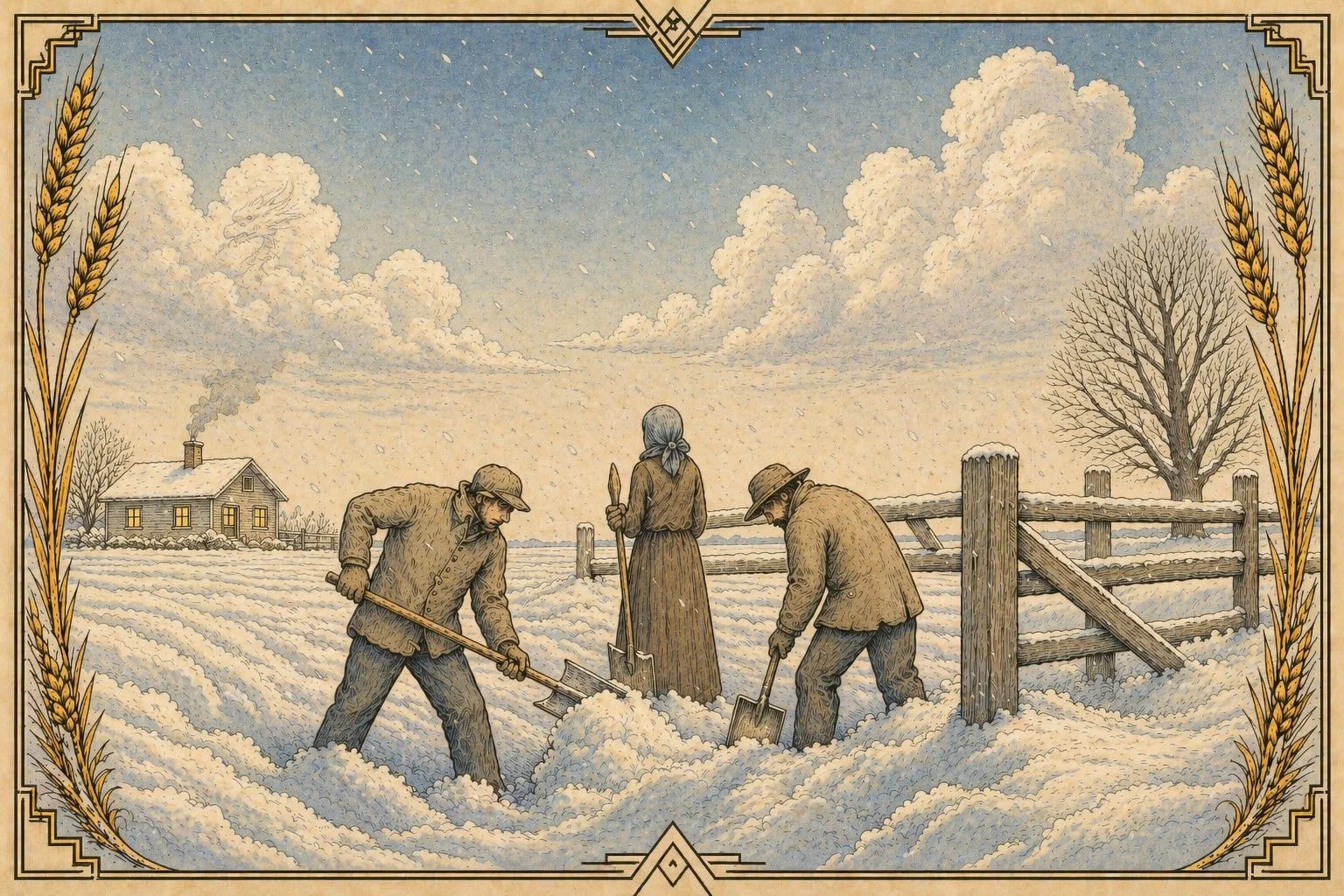
The Weatherdragon Chronicles · Season One
Episode 4: Flurry Runs Late
The snow was already wrong before breakfast.
Not much of it. Only a light, dry drifting that moved in uneven threads across the pasture. It hung over the fields like flour shaken through a sieve. From the kitchen window, the farmer’s wife called it a harmless little dusting. The children in the yard called it pretty. The hens objected noisily, then settled under the wagon. The dog paced the porch steps, sneezed, and refused to go farther.
The farmer stood by the split rail fence, one gloved fist resting on a post gone silver with age, and watched the pale sky.
There, above the low western rise, Flurry was in a rush.
The young dragon came hurtling through the morning, a loose tumble of white wings and bright movement, too fast for the weather he carried, not steady enough for the work. Snow streamed from him in broken ribbons, blanketing homes and fields unevenly. Where it should have fallen in a soft sweep over the prairie, it scattered in starts and stops: thick in one place, thin in another, a clumsy shaking out of winter. He seemed intent on making up lost time.
Flurry swerved sharply over the far field, overshot the turn of the river, wheeled back in evident embarrassment, and flung a sudden burst of snow into the cottonwoods.
The farmer let out a slow breath through his nose.
“Well,” he said quietly, “you have already made a morning of it.”
The cattle had been uneasy before dawn. He understood why now. Animals sensed what people could not. The mare in the lower pasture had kept her ears pinned toward the sky since first light. Even the milk cow, patient creature that she was, had moved and stamped while he worked next to her, as if some hurrying spirit passed overhead and troubled her calm.
Behind him, the kitchen door opened with a wooden creak. His wife came onto the porch carrying the tin pail of scraps, her shawl tucked high by her throat.
“You’ve got that look again,” his wife observed.
He turned slightly. “What look?”
“The one that means you’re listening to something I can’t hear.”
He smiled a little at that, though not with any amusement that lasted. She did not mock him. She never did. She only named what she saw, as she always had.
“It’s an odd sort of snow,” he noted.
She looked up into the gray morning. “It looks harmless enough.”
“For now,” he agreed.
She tipped the scraps to the chickens, who ran in a fluster of feathers, then paused with the empty pail hooked in her arm. “Nell Harper’s boy is meant to ride over from town this morning, isn’t he?” she inquired.
The farmer nodded. “For the harness buckle.”
“And the cloth I asked for.” She drew her shawl tighter. “I hope he started early. The road will be worse if this keeps up,” she continued.
The farmer looked east, where the track curved past the neighbour’s line and dipped through a shallow place before turning toward town. Nothing moved there yet. Only the whitening of the ruts and the dark stubble of dead grass showing through.
Inside the house, one of the children giggled, and another shushed him over some game at the table. Warmth glowed from the windows. The smell of biscuits and coffee came through the open door.
It was the kind of morning that ought to have remained small.
A little weather, a little waiting, a rider coming late with needed things.
Nothing more serious than an inconvenience.
But Flurry, high above the barn, overshot again.
This time, he tried to correct too quickly. He folded one wing, twisted again with fresh confidence, then flung a longer veil of snow slanting hard across the lane. The dragon’s outstretched body swept the white drift forward. It struck the fence and filled the wheel tracks. It spun onward toward the pasture gate in a gust far heavier than the rest of the morning warranted.
The farmer’s mouth tightened.
Across the yard, under the shelter of the eaves, his younger son had come out without his coat and was staring upward, not seeing the dragon, only the strange liveliness of the weather.
“It wasn’t snowing like this a minute ago,” the boy remarked.
“No,” said the farmer. “It wasn’t.”
The boy squinted into the white air. “Do you think school will be called off?”
“There is no school today.”
“I know, but it feels like the kind of weather that ought to cancel something.”
The farmer smiled at that, then set a hand on the child’s shoulder. “Go get your coat on,” he instructed, turning him towards the house.
By midmorning, the simple dusting had become a nuisance, and the nuisance had begun to show signs of turning foolish.
Snow gathered where it shouldn’t, the telltale result of the dragon’s wild flights. The lane had drifted over in low ridges as wind eddies curled behind his passing wings. The open field beyond remained only lightly brushed. The roof of the woodshed wore a tidy white cap, but the porch steps below lay nearly bare, swept clear after a close, fiery passage. The barn had one side sugared thickly to the windows, but the other side was only weathered boards and nailheads. Each time the farmer went outside, the pattern shifted, as though some uncertain, scaled hand kept trying to set things right, but only made things worse.
Above, Flurry hurried, doubled back, and hurried again.
He was beautiful, as all of them were. But youth showed plainly on him. His scales shone like new ice in shadow, and his crest caught light shining through clouds. Snow fell from his wings in powdery sighs. Evenfall moved with grace. Flurry moved with neither.
He missed his line over the north pasture and had to go back.
He dropped too much snow on the creek path and too little on the exposed turn by the ridge.
He came in low above the Harper road and lifted in alarm as the wind caught his own work and flung it against him.
The farmer watched from the barndoor while fitting the repaired trace to the harness. “You’re trying to mend a thing by hurrying it,” he muttered.
One of the horses swivelled its head as if to listen.
✱
Near noon, a rider finally appeared.
Not Nell Harper’s boy, as expected, but his older sister Ruth, wrapped in a brown coat and a firmly tied scarf. She rode their sorrel mare with the stiff posture of someone who wasn’t just cold.
The farmer saw her first as a moving smudge through the whitening lane.
His wife saw her a moment later and came to the door. “That’s not Thomas.”
“No.”
“Why would they send Ruth in this?”
The farmer did not answer. Another thing had already caught his attention.
Flurry, who until then had been working the western fields in blundering patches, suddenly noticed the rider.
Flurry swept eastward, eager and unguarded, cutting across the lane above Ruth’s head. His passage stirred the snow he had already laid there, creating a sudden, blinding swirl. What had been a troublesome drift under his earlier passes became, all at once, a whiteout that hid the road and spooked the horse and rider.
Ruth pulled her mare up short.
The horse shied sideways and nearly fell into the ditch. Ruth checked her hard, bent low over the neck, and spoke firmly. The mare pranced in place, eyes staring wide and steam blowing from her nostrils.
The farmer had the barn door open and was in the yard before his wife could call after him. He reached the lane just as the worst of the swirl passed. Ruth sat stiff in the saddle, cheeks tinged in cold and anger.
“I had it,” she insisted before he could speak. “I had her steady until the wind suddenly changed.”
He put a hand on the bridle. “You did.”
Behind them, Flurry circled once in visible dismay.
The farmer looked up only briefly. The young dragon hovered at an uncertain distance, snow still feathering from his wings. He seemed to understand, at least in part, that he had made things worse. Yet his very distress sent another fretful stirring through the air.
“Best come in,” the farmer urged.
“I can still get back before it worsens.”
“It’s already worse.” He spoke gently, but in a tone that brooked no room for argument. “Come warm yourself,” he added.
Ruth pursed her lips together. She was seventeen, perhaps eighteen. Old enough to prize being treated as dependable. Young enough to feel the injury quickly when circumstances said otherwise.
“I told my father Thomas should’ve come yesterday,” she said as she swung stiffly down from the saddle. “But Thomas forgot, and then this morning he said the road wasn’t fit, and Father said someone had to bring the things, and I was tired of hearing them talk.”
The farmer’s wife, who had come out still in her apron, took the parcel from Ruth’s gloved hands. “You’re half frozen. Come inside,” she urged.
Ruth hesitated only a moment before following her to the house.
The farmer led the mare toward the barn, speaking low to her until the trembling eased. The animal rolled one eye toward the sky. He did not need to look up to know Flurry was still there.
“You shouldn’t have come near the road at all,” the farmer said under his breath.
A thin whirl of snow crossed the barn threshold in response.
Inside, the house filled with the noises of people settling, chair legs shifting, the kettle being moved, and children being hushed. Ruth sat beside the stove, a blanket around her shoulders and a cup cradled in both hands. Her face, once the chill had left it, revealed something more than irritation. Hurt sat under it. The farmer had seen that look before in grown men and children alike, the stubborn look of a person determined not to care that they had been taken for granted.
His wife, slicing bread at the table, drew it out gently.
“So Thomas forgot the errand.”
Ruth gave a short laugh that was not laughter. “He forgets anything that isn’t his own concern,” she said bitterly.
“Your father sent you because you’re more reliable?”
Ruth stared into her cup. “My father sent me because someone had to come, and because when a daughter demonstrates determination, folks only call it helpful.”
The room was silent.
The farmer bent over the harness buckle. The room had gone quiet around her words.
Outside, Flurry gave an anxious, uneven pass over the roof, dusting the windowsills white.
The farmer looked up.
In the sky beyond the window, he saw another form now, higher, steadier, violet and indigo merging with the pale noon. Evenfall had come.
She did not descend at once. She moved in long, graceful measure above the farmstead, taking the shape of the wind in hand by presence itself. The scattered snow under Flurry’s disorder softened. The loose eddies began settling. The fresh, clean air seemed to remember the right way to move.
Flurry rose toward her and then faltered, as a child might approach a mother already knowing he had made a poor account of himself.
Evenfall did not rebuke him with force. She turned one luminous eye toward the lane, where the half-drifted ruts lay crooked and confused.
The farmer kept his hands still on the table. Ruth, beside the stove, rubbed warmth back into her hands. The children had gone quieter again for reasons they could not have named. Animals noticed. Children noticed. Some moods arrive in a house like the weather before the rain.
The wife glanced toward the window. “I think it’s easing.”
He nodded. “Yes.”
After lunch, the farmer hitched the team. Ruth protested that she could manage home on her own, which confirmed to everyone in the room that she ought not be left to do it. His wife packed a small sack with the Harper cloth, a jar of preserves, and two rolls still warm from the oven, though Ruth insisted those were unnecessary too.
“Most good things are called unnecessary by the person wanting them,” the wife said, tying the sack shut. “But that doesn’t mean they aren’t welcome,” she said with a smile.
Ruth had no answer to that.
Before leaving, the farmer stood a moment in the yard and looked upward. Evenfall remained, serene and watchful. Flurry hovered lower now, no longer rushing, though shame seemed to have made his white brightness dim.
The farmer tucked the blanket around Ruth’s knees once she sat beside him on the wagon seat.
✱
They took the lane carefully because the snow still lay awkwardly in all the wrong places, but at least the wind had settled.
Here and there, the farmer could see where Evenfall’s influence had corrected the worst of Flurry’s mess, not by erasing it all, but by smoothing the rough edges, settling drifts, and guiding the snow to where it could lie naturally.
She had not erased the morning’s damage. She had only set it to rights where it lay.
Ruth stayed silent for the first mile.
Then she said, “Everyone says Thomas will come into the farm as if that’s guaranteed by law.”
The farmer kept his eyes on the road. “Does Thomas want it?”
“He wants whatever is easiest and to be warm indoors.” She looked out over the fields. “I know how to keep accounts. I know stock. I can see a bad wheel before my father hears it. I can set a fence, milk in winter, judge a heifer, and remember a simple errand. But Thomas is a son, and sons are assumed to have some kind of right to everything.”
The horse’s harness gave a soft jingle. The road dipped. Snow whispered under the runners of the wagon.
After a while, he said, “Being counted dependable can become a kind of neglect, if people use it to spare themselves the trouble of honouring you.”
Ruth turned and looked at him.
“No,” she said after a moment. “It only makes a person tired.”
Above the lane, Flurry followed at a distance.
The farmer felt rather than saw his uncertainty. The young dragon wanted to help and did not yet know how. More than once, he would drift near a bank of cloud and then draw back, as though scared to lay one snowflake more than Evenfall would approve of.
When they reached the shallow crossing near the Harpers’ place, they found Thomas there with a shovel and a face set in defensive misery. He had been trying to clear the drift that blocked the final turn to the house and had made poor progress. Snow streaked his coat. His hat sat crooked over one ear. He looked up at the wagon and then at his sister, and all at once his look revealed a shame he had likely been protecting all day with excuses.
“I was coming,” he said.
Ruth did not answer.
Mr. Harper emerged from the yard gate soon after, broad-shouldered and red-cheeked from the cold. He took in the scene, the wagon, his daughter returned under escort, his son at the drift, the sack from the farmer’s wife, the mare not brought back alone, and his own face altered too. Not dramatically. This was not a family given to displays. But the man’s mouth lost its certainty.
“I should not have sent you,” he said to Ruth.
She looked at him with surprise so plain it nearly hurt to witness.
“I said the road might turn,” he went on. “And I knew Thomas had missed the errand. I let annoyance do my deciding.”
Thomas lowered his shovel.
The farmer, who had seen many apologies spoiled by self-justifying additions, waited. Mr. Harper did not spoil this one. He only walked over and took the sack from the wagon, then set it down again as though it were the least of what mattered.
“You are not the one to mend every error in this house,” he said to his daughter. “I have treated you as if your willingness was expected.”
The wind moved lightly through the fence wire.
Ruth drew one breath, then another. “I was angry.”
“You had cause.”
Thomas, still standing in the half-cleared drift, blurted out, “I forgot because I thought there would be time. Then, when there wasn’t, I let her carry it.”
That, too, was better than an excuse.
The farmer looked up.
Flurry had come to rest on a low bank of cloud over the Harper field. He folded his wings close around himself, his white head bent. Evenfall remained above and behind, distant enough to let the moment belong to those below.
For a while, no one moved much. Then Mr. Harper took the second shovel from the wagon bed. He handed it to Ruth.
Not as a command.
As an invitation.
“Come finish this with us,” he said.
Something in her face eased. Not all at once. Not completely. But enough.
So the three Harpers worked the drift together while the farmer steadied the team and watched the snow begin, at last, to fall properly.
Then her sound came, not through the ears but through the farmer’s inward hearing, clear, resembling twilight over water.
“What was yours to carry?”
Flurry’s answer came after a long moment, quieter than his morning movements had been.
“A light pass over the southern fields, then the school road, and finally the creek bend after noon.”
“And what did you carry?”
He looked down over the whole farm, the lane, the roofs, the trees, the troubled road. Snow fell from his wings in a sorrowful little stream.
“More than I could place well.”
Evenfall wheeled once through the upper gray. “When you are late, do you mend lateness by grasping more?”
Flurry said nothing.
It came in a fine, even descent now, quiet as breath against wool. No panicked gusts. No clumsy heaps where the road should stay passable. The fields took on a modest white blessing, sufficient for the ground, not burdensome to the lane. Flurry rose slowly from the cloud bank and moved along the fenceline with deliberate care, laying the snowfall in measured grace. Every pass of his wings was thoughtful now. He no longer seemed keen to prove he could do much. He only tried to do well what was his.
When the drift had been cut through, Mr. Harper came to the wagon and rested both hands on the sideboard.
“My thanks,” he said to the farmer. “And to your wife.”
The farmer inclined his head. “Loads are easier when they’re not carried by one person.”
Mr. Harper gave him a strange look at that, as if he suspected more meaning than the words openly claimed, then nodded once.
✱
On the ride home, the afternoon had settled into that pale, silver-white hush particular to winter weather, when the sky has finished arguing with itself.
The farm appeared gradually from the snowlight: the roofline first, then the barn, then the dark line of cottonwoods by the creek. Smoke rose cleanly from the chimney. A child had opened the front door before the wagon fully entered the yard. Warmth was visible from outside.
Above the house, Flurry made one final pass.
This time his snow fell in a level, gentle sweep that covered the south field evenly and laid a proper powder over the school road beyond. He turned once, looking upward, where Evenfall glided in long, approving silence.
Then, to the farmer’s inward ear, came Flurry’s voice, young still, chastened, but more steady than this morning.
“If I am late again, I will keep my loads small.”
Evenfall answered, “Not small. True.”
They passed eastward together, mother and son, until the cloud took them.
That night, the family sat after supper with the lamp low and the wind quiet at the walls. The children spoke of the ride, and of Ruth Harper’s mare, and of whether the snow would hold until morning. His wife mended by the fire. The house smelt of wool drying, ashes cooling and bread kept back for breakfast.
After the children had gone to bed, she looked across the room at him.
“You were troubled by more than the road today.”
He considered denying it, then did not. “Yes.”
She set down her mending for a moment. “Ruth looked like someone who had been asked to be strong, but everyone seems to have forgotten what it costs her.”
He nodded.
His wife’s hands were folded in her lap. “That happens in families. Sometimes, it’s with the child who complains least. Sometimes with the one who can manage more. People begin to lean without meaning to.”
Outside, a small last sift of snow moved off the eaves.
He looked toward the window, though nothing was visible there but his own faint reflection and the dark beyond. “And sometimes,” he said, “the one who makes the mess means well.”
“That is common too,” she said, with a tired gentleness that suggested she was thinking not only of the Harpers. “Good intentions are not nothing. But they are poor sled runners in deep weather.”
He smiled at that.
Then the smile faded to thought.
The room had gone very still.
At length, his wife took up her needle again. “Was it only weather?” she asked, not because she believed it was, but because she knew he would hear the question the way he needed.
He looked into the fire, where the wood collapsed softly inward and sent up one brief coil of sparks.
“For most,” he said.
“And for you?”
He listened to the quiet house, the sleeping children, the settled cattle, the snow resting at last in its rightful places.
“For me,” he said, “it was a young hand learning not to scatter what it meant to carry.”
His wife did not ask what he meant by that. She only nodded, as if some part of the truth had reached her by another road.
Outside, under the calm winter sky, the lane lay passable, the fields lay covered, and all the town would say by morning was that the snow had turned out kinder than it first appeared.