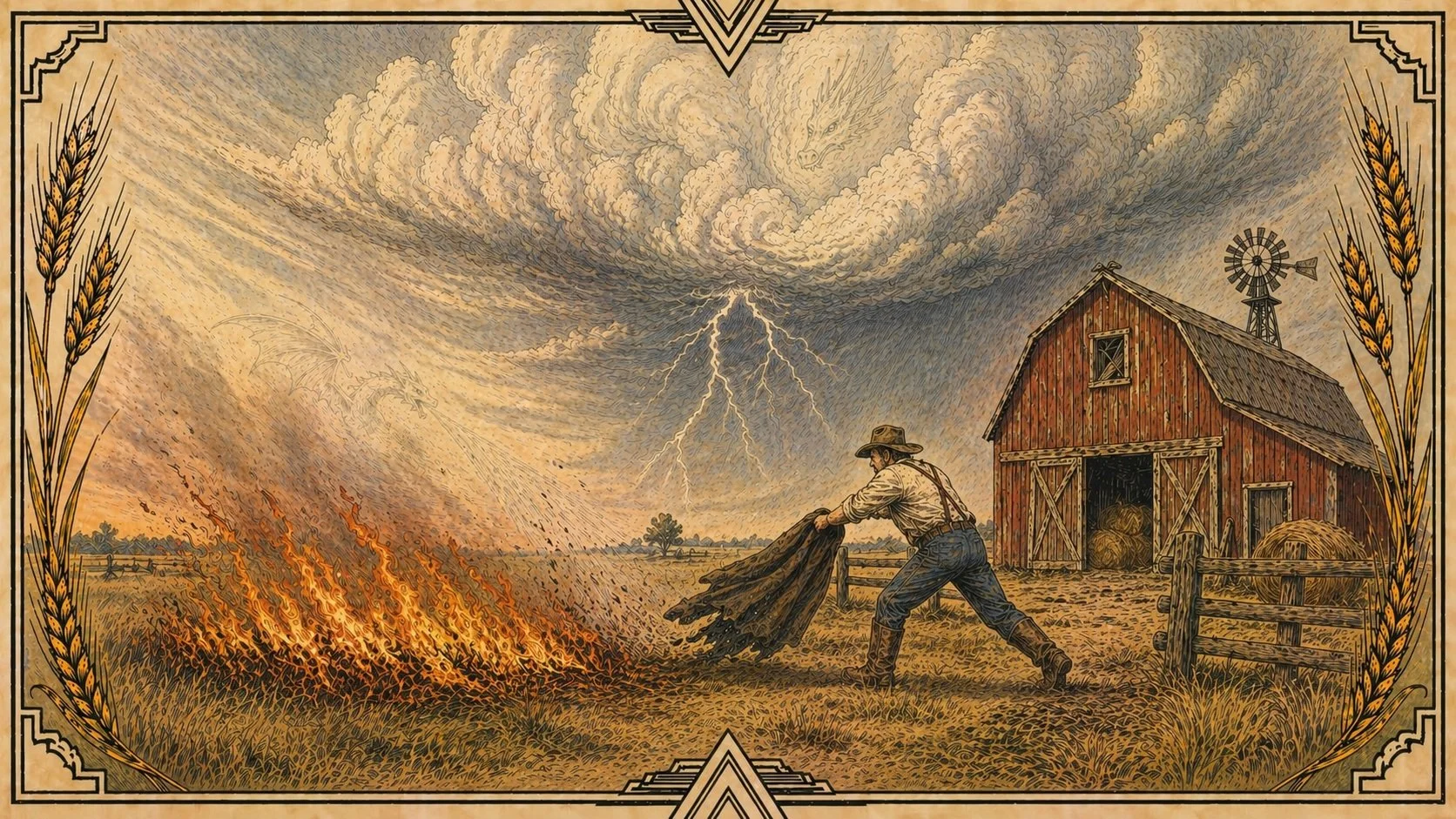
The Weatherdragon Chronicles
Episode 6: The Fire in Dry Grass
The day began too bright.
Not beautiful, bright. Not the clean, generous brightness of washing hung in a good wind or wheat lifting under a wide blue sky. This brightness had a hard, pressured quality. The light seemed to strike the fields rather than rest on them. The prairie grass beyond the barn had cured to a pale, thirsty gold, and every board on the south side of the house looked drier than wood ought to look in a living place.
Above it all, the Weatherdragon moved in the high air.
The farmer noticed it at once.
The farmer saw him just after sunrise, a dark blue immensity crossing slowly from west to east with long, measured strokes of his wings. The lightning-like markings along his flanks did not flare brightly. They glowed in contained threads, as if something powerful was being kept in careful order. He was not alone. Evenfall moved farther south, luminous and graceful in violet and indigo, gliding along the edge of a thin bank of cloud. Flurry trailed lower and behind, bright and eager, keeping pace in quick corrections that made plain he was trying very hard to appear steadier than he felt.
The farmer stood at the yard pump, a bucket half full, and watched all three.
His wife came out with the wash basin and followed his gaze only as far as the empty blue.
“You’re studying the sky again.”
“Yes.”
“Storm?”
“Maybe.”
She set the basin down and tested the air with the practical instinct of a woman who had judged weather all her life without seeing what he saw. “Doesn’t feel near.”
“No,” he said. “Only loaded.”
That was the word for it.
Loaded.
Not a sky bent on violence. A sky bearing force.
Evenfall’s flight was smooth but attentive. The Weatherdragon held his altitude with unusual care, as if balancing more than one danger at once. And Flurry—dear, earnest Flurry—kept drifting too close to his father’s wake, then correcting, then drifting again, trying to be useful in weather that was larger than his years.
The cattle were restless by midmorning.
So were the hens, and the dog.
Even the old mare in the lower pasture kept lifting her head from grazing and turning one ear toward the ridge beyond the east field, where the grass ran high and dry all the way to the road.
The farmer noticed such things because he had learned that animals sensed the dragons as creatures before men ever admitted the wind as pressure. A cloud to human eyes might be a presence to a horse. A storm front might feel, to a dog, like a great unseen body crossing the land.
His younger son came running from the barn lot carrying a length of rope and a question that had already been asked twice that week.
“Can I go with you to town tomorrow?”
“We’ll see.”
“That means no until supper.”
“It means I do not answer road questions before noon.”
The boy accepted this as one accepts weather: not gladly, but without surprise. He looked up at the hard brightness and squinted. “It smells dusty.”
“It is dusty.”
“Will it rain?”
The farmer glanced skyward once more, seeing the Weatherdragon turn in a broad, silent arc. “Maybe,” he said. “But not idly.”
The morning passed in ordinary chores.
He mended a hinge on the chicken run and then checked the water barrel by the kitchen garden.
He and his older daughter carried two sacks of feed from the wagon shed to the barn while his wife worked baking bread, and the children argued over whose turn it was to gather chips for the stove.
Nothing in the rhythm of the place invited disaster. That was part of what made such days dangerous. A life can appear so wholly given to modest necessity that one forgets how quickly one spark can ask everything from it.
By noon, the heat had deepened. Not high summer heat, but the dry, pushy warmth of a day that has forgotten gentleness. Wind came and went in shallow breaths. The grasses hissed against one another near the road. A pair of crows crossed low over the pasture and then turned sharply north, avoiding the ridge.
The farmer was at the far side of the barn, sorting old boards that could be cut for patching, when he felt it.
Not heard.
Not seen.
Felt.
A tightening in the air.
He straightened and looked up.
The Weatherdragon had descended.
He was no longer a distant majesty in the upper blue. He moved now within a thickening bank of cloud assembling over the eastern ridge, dark and immense, his body half-veiled in gathering gray. The pale lines along his sides brightened once, then dimmed again. He was holding something.
Evenfall rose beneath him, elegant and calm, weaving cool vapour through the lower cloud as if preparing paths before they were needed. Flurry darted farther out over the grasslands, white-bright against the deepening sky, then doubled back too quickly. His uncertainty carried plainly even at that distance.
The farmer dropped the board in his hands.
His wife, watching from the kitchen doorway, saw the movement and knew at once that something had changed. “What is it?”
He turned toward the east ridge. “Keep the children close to the house.”
She did not ask why. She only called the children in a tone that ended questions before they formed.
The first lightning came so fast that it seemed less like a strike than a tearing of the day.
It split from cloud to ground beyond the barnyard, over the rise where the dry grass ran thick along the east pasture. The sound followed a beat later, hard and close enough to shake dust from the rafters.
The younger children screamed.
The mare reared against her fence.
The dog barked and then retreated under the porch.
For one instant, everything held still.
Then a thin line of orange lifted in the grass.
The farmer ran.
Behind him, he heard his wife shouting for the older daughter to keep the little ones inside. He heard the slam of the kitchen door, the scrape of a bucket snatched up, the barn swallows flurrying out from the eaves. But his eyes were on the slope.
Fire in dry grass never looks large at first.
That is part of its deceit.
It begins as a thread.
A bright stitch.
A little crawling edge where one ought not exist.
Then the wind remembers it.
By the time he reached the lower fence, the thread had become three separate tongues of flame moving low and quick through the gold. The grass did not resist. It yielded. Fire ran through it as if some hidden road had always been waiting there.
The barn stood downwind.
That was the measure that mattered.
If the fire crossed the shallow ditch at the foot of the slope and reached the barn grass, the whole place could go in minutes—hay, boards, harness, animals, winter feed, perhaps even the house if sparks took the roof.
The farmer vaulted the fence and beat at the nearest line with his coat, knowing it was a poor first answer but the only one within reach. Fire crouched and leaped away from each blow. Smoke lifted thin and bitter into his face.
Then the dragons moved.
The Weatherdragon descended through the cloud with terrifying authority. His great dark blue body cut across the sky over the ridge. Lightning traced silently along his flanks, not wild now, but disciplined into lines of force. Lightning did not strike again as he held the storm above him like a great burden under command.
Evenfall swept low over the ditch, her indigo wings stirring a cool, concentrated current that pushed the smoke sideways and slowed the nearest flames where they bent toward the barn. Her motion was graceful, every pass was exact.
And Flurry—
Flurry came too fast.
The young dragon plunged low over the burning grass, beating his pale wings with every ounce of eager courage in him. Snow did not belong to this weather, yet some trace of his nature rode with him—a cold draft, a scattering of fine white crystals that flashed and vanished in the heated air. He meant to smother the fire by force of hurry.
Instead, he fed one edge of it.
The gust from his wings drove sparks farther down the slope.
“Too low!” the farmer shouted, though no human voice could guide dragon-work.
Flurry jerked upward in alarm, seeing what he had done. The sparks he had stirred landed in the brittle grass near the ditch and bloomed there at once into a new line of flame.
For a moment, the fire stood in two places.
The farmer’s heart dropped.
From the yard, his older son came running with a shovel despite orders to stay back. “Pa!”
“Get to the ditch!” the farmer shouted. “Beat the edge where it’s thin!”
The boy obeyed at once, face pale but set.
Together they struck at the low flames with shovel and coat and armfuls of damp earth scraped from the ditch bank. The fire hissed and spat, still advancing. Smoke thickened. The air became its own labour.
Overhead, the Weatherdragon gave voice at last—not in spoken words first, but in a thunderous call that rolled through the sky and over the fields like a command no weather could mistake.
Flurry froze mid-flight.
Something reached him then—not words exactly, but the weight of them, the shape before the syllable.
“Courage without measure is another danger.”
Flurry hovered, white scales dimmed by smoke and shame. “I was helping.”
“You were trying.”
Weatherdragon’s great wings held the storm in place above the ridge. Lightning moved within the cloud but did not descend. The discipline in that restraint was more fearsome than any display could have been.
Evenfall swept past the widening fire line once more, cooling, narrowing, guiding the smoke so the farmer and boy could breathe between gusts. Something in her passage carried direction more than sound.
“See where the fire wants to go. Help there.”
Flurry turned.
This time, he did not rush the whole blaze. He looked—truly looked—at the grass, the wind, the ditch, the direction of the sparks, the path toward the barn. He had the expression, the whole bearing, of one young enough to feel his mistake deeply and good enough not to flee from it.
He rose, circled once, and then dropped, not over the broadest flames but over the far edge where sparks threatened the driest run toward the barn.
His wings beat in short, measured strokes now.
Cold rode the air behind him—not snow, not winter, but a sharp thinning of heat. The sparks on that edge faltered. The grass there, instead of igniting in a line, blackened, smoked, and died.
The farmer saw the difference at once.
“Again!” he shouted to his son, though the cry was for both boy and dragon.
The son drove his shovel into the ditch bank and flung earth over the weakened edge. The farmer beat down another flare. Evenfall lowered once, twice, drawing a cool path along the front nearest the barn. The Weatherdragon remained above, immense and burdened, holding back the larger violence in the storm so that one danger did not become many.
The younger children were crying at the house now. The farmer heard it faintly through the smoke and wind. His wife came from the yard carrying two full buckets and no wasted motion. She did not run foolishly into the center of the fire. She went where the ditch narrowed and poured water over the grass nearest the fence posts, protecting what could still be kept from catching.
“Take the red bucket!” she called to the daughter behind her.
“I’ve got it!”
The older daughter arrived breathless, skirts hitched up, hair coming loose, carrying more water than a child ought to carry comfortably, and not stopping to say so. She looked once at the fire, once at her father, and took a position near her mother without a word.
This was the family under pressure, the farmer thought in one sharp inward instant—human below, dragon above—and no part of it grand from the inside. Only work, fear, and the next necessary act.
The wind shifted.
That should have worsened everything.
Instead, the Weatherdragon moved.
He descended lower than before, so near the cloud floor that the whole eastern sky seemed built around him. The lightning markings along his body flared once in stern blue-white channels, and with one immense sweep of his wings, he bent the wind—not stopping it, not breaking the order of weather, but turned its force just enough that the fire’s longest tongue leaned away from the barn and toward the already blackened ground.
The power of it shook the cottonwoods.
The farmer felt it in his bones.
That, he knew, was what greatness looked like in the Weatherdragon: not the making of destruction, but strength governed precisely where panic would have spent it wildly.
“Hold this line!” he shouted.
Now they had one.
The family worked it together.
The farmer and his son beat and buried.
The wife and daughter soaked and smothered.
Flurry flew the spark-edge again and again in careful, exacting passes, no longer trying to conquer the whole fire, only to keep it from leaping where it must not.
Evenfall cooled the near runs and spread the smoke.
The Weatherdragon held storm, wind, and flame in a hard balance only he was broad enough to bear.
Minutes stretched longer than ordinary time.
A fence post smoked and then darkened without fully taking.
One patch of grass near the ditch flared so suddenly the farmer thought it lost, but his daughter reached it first with the last of the bucket.
The son stumbled, coughed hard, and rose again before anyone could call him back.
Ash from one of Flurry’s passes struck the farmer full in the face; the young dragon corrected immediately, pulling up with steadier wings.
At last, the fire began to lose its will.
That was how it seemed—not extinguished all at once, but persuaded into smaller hungers. The broad running line broke into patches. The patches shrank into angry clumps. The clumps into smoking black grass with red veins underneath.
Then the rain came.
Not a downpour.
Not the kind of storm that would have flattened the whole place and called itself rescue through sheer force.
A measured rain.
The Weatherdragon released it only when the fire had been narrowed enough that water could finish without spreading chaos elsewhere. The drops were large and cold. They struck the black ground, hissed on the glowing roots, and darkened the ash to mud. Evenfall guided the rain in bands over the burn while leaving the yard and house under only a gentler fall. Flurry, exhausted now, made one final pass along the ditch edge and then rose shakily into the low cloud, his chest heaving.
The farmer finally lowered his coat.
Smoke drifted upward in torn gray sheets.
The burned patch on the slope looked ugly and raw, a black wound in the pale grass.
The barn still stood, and the house still stood.
The cattle were frantic but alive, and the fence held its scorched posts.
His wife set down the empty bucket and bent forward with both hands on her knees, not from weakness but from the body’s rightful claim after fear.
The older daughter stood beside her, ash-smudged and wet-haired, breathing hard.
The son wiped his eyes on his sleeve and tried not to appear as shaken as he was.
The farmer looked at them one by one and felt gratitude arrive with such force it brought a tear of gratitude to his eye.
Rain softened to a drift while above the field, the dragons remained.
The Weatherdragon moved lower over the blackened grass, no triumph in him, only grave completion. Evenfall glided beneath him, her violet form luminous against the storm’s thinning edge. Flurry hovered apart, head lowered, white wings sagging with weariness and shame.
✦
The farmer stepped away from his family for a moment and lifted his face to the rain.
Flurry spoke first, his young voice shaken.
“I made it spread.”
The Weatherdragon did not answer immediately. The pause itself was an instruction.
“Yes,” he said at last.
Flurry folded his wings tighter. “I thought speed would prove I was ready.”
“Readiness is not proved by speed.”
Evenfall passed between them, calm as evening over troubled water. “But neither is it learned by simply watching.”
Flurry looked up.
Rain jewelled along his pale scales.
Smoke had grayed one side of his face.
He looked terribly young.
“I was afraid to do nothing,” he said.
The farmer understood that with a force that had no adequate name.
The Weatherdragon’s answer came low and resonant, like thunder after the strike has already taught its lesson.
“To do only what is yours in danger—that is key.”
Flurry listened.
Below, the farmer’s son was watching him without seeing him, eyes fixed on the thinning rain as if some truth in the weather had almost come close enough to touch.
The wife began directing the children back toward the house in her practical voice. “Boots off at the door. Not in the middle of the floor. Ruth, get towels. Ben, wash your face before your little brother thinks soot is a holiday.”
Ordinary speech, immediate and unspectacular, lay over the shaken hour like a blanket over trembling shoulders.
The farmer stayed a moment longer.
Flurry descended carefully then, not all the way to the ground, but lower than a dragon usually came over settled human places. He passed above the blackened patch where he had first worsened the sparks, then along the protected ditch where he had later helped stop them. His gaze moved from one to the other.
The farmer thought he would speak again, but instead the young dragon only traced the line with his eyes, as though committing the difference to memory.
Evenfall watched him with deep, quiet approval.
The Weatherdragon turned westward. The heavier cloud went with him, withdrawing in broad folds across the prairie. Rain lessened to mist, and the hard brightness of morning was now gone. In its place lay washed air, the dark smell of wet earth, and the raw, sobering sight of what had almost been much worse.
✦
By evening, the whole family had changed clothes twice—once because of smoke, then again because of rain and mud—and the kitchen was full of damp garments hanging from chairs and door pegs. The children spoke of little besides the fire. The younger ones told it too dramatically; the older two corrected them; the wife kept putting food in front of everyone until bodies stopped trembling enough to remember appetite.
At supper, the son who had run with the shovel sat straighter than usual, as boys do when they have done one hard thing and are quietly asking the world to notice. His mother noticed by giving him the larger piece of cornbread without remark. His father noticed by not calling attention to the cough the smoke had left in him. Both forms of notice were love.
The daughter said, “I thought the fence post was surely gone.”
“So did I,” said the wife.
The younger boy asked, “Did the lightning aim at us?”
“No,” said the farmer. “It struck dry ground near us.”
“Why there?”
No one answered at once.
The schoolteacher, if asked, would have had an answer about charge and air and the honest science of storms. The answer would not have been false. Yet neither would it have reached the whole of what the farmer had seen.
His wife spared him the need to bridge that distance. “Sometimes danger comes near enough to show you what matters,” she said.
The child considered this over his potatoes and accepted it as sufficient.
After the meal, once the dishes were washed and the younger ones put to bed, the farmer stepped out alone.
The burned patch on the slope was visible even in dusk, a dark shape against the dampened field. Steam rose faintly from parts of it where the ground still held the day’s heat under the rain’s cooling hand. The barn smelled of wet hay and frightened animals settling at last into trust again.
Above the eastern horizon, the last of the storm cloud receded.
Flurry lagged behind the others.
He flew low and slower than usual, no longer eager to prove himself, and for the first time, the farmer saw not merely his youth but the cost of his good heart. Flurry did not suffer from indifference. He suffered from wanting to be more than he yet was.
Evenfall glided back to him.
Together they hung in the dimness over the blackened grass.
Her voice came soft as evening rain.
“Do you know the place where you failed?”
“Yes.”
“Do you know the place where you learned?”
Flurry looked along the ditch line, the saved fence, the standing barn.
“Yes.”
“Then keep both.”
They remained there a moment in shared stillness.
Then the Weatherdragon’s call came from farther west, deep and resonant. Not impatient. Summoning.
Flurry lifted his head and followed.
The farmer stood with one hand resting on the porch rail, listening to the frogs begin cautiously at the creek now that the rain had settled and the danger passed. Behind him, through the lamplit window, he saw his wife folding a smoke-stained shirt, her movements slower now that urgency had left the day. One child had already fallen asleep at the table and been left there for a minute longer out of parental mercy. Another was tracing the shape of the burned patch on the windowpane fog with a fingertip.
The ordinary life of the house had returned.
Yet not unchanged.
He understood something now about family under strain that the sky had shown him plainly. Not as a lesson he could have put in words, but as a thing felt in the body—the ache in his arms, the sight of his wife’s hands on her knees, his son rising from a stumble. Each of them had found the right place to stand when it mattered, and none of them had done it alone.
The Weatherdragon had borne the largest force.
Evenfall had seen where precision mattered.
Flurry had failed, learned, and returned to the work.
And below them, his own family had done much the same on a human scale.
✦
When he came back inside, his wife looked up from the folded clothes.
“Well?” she asked quietly.
He unbuttoned his damp cuffs. “The worst has passed.”
“I know that,” she said, studying him, “but something else did not.”
He sat down by the stove, feeling the ache in his arms settle into him now that there was time for it. “No.”
She waited.
He looked toward the dark window. “A young one tried to be brave before he was ready.”
Her hands paused over the shirt in her lap. She could not see what he had seen, yet she heard enough to answer wisely all the same.
“That can be corrected,” she said. “Better than cowardice can.”
He looked at her.
She shrugged one shoulder with tired gentleness. “Courage that must be taught might be troublesome. But courage that is absent leaves little to work with.”
He let out a slow breath that might almost have been a laugh.
“Yes,” he said. “That is so.”
She rose then, came behind him, and laid one hand briefly on his shoulder. It was not a dramatic comfort. Only the touch of one person who had stood with him through danger and knew the body remembers long after the flames are gone.
Outside, the burned slope cooled as the night deepened. By morning, the town would say that lightning had struck the dry grass, and the rain had come in time. Men would inspect the blackened patch, measure the luck of the ditch, and speak sensibly about how close the barn had come.
Only the farmer would know how much discipline had been required in the sky above it.
Only he had seen the storm dragon hold back a greater force, the violet dragon guide mercy precisely, and the young snow-bright son learn that help given rightly can save what hurry endangers.
And as the house settled around him and the night deepened into quiet, the farmer thought the truest thing was not that fire had come.
It was that when it did, each member of the family had been asked to become more exact in love.