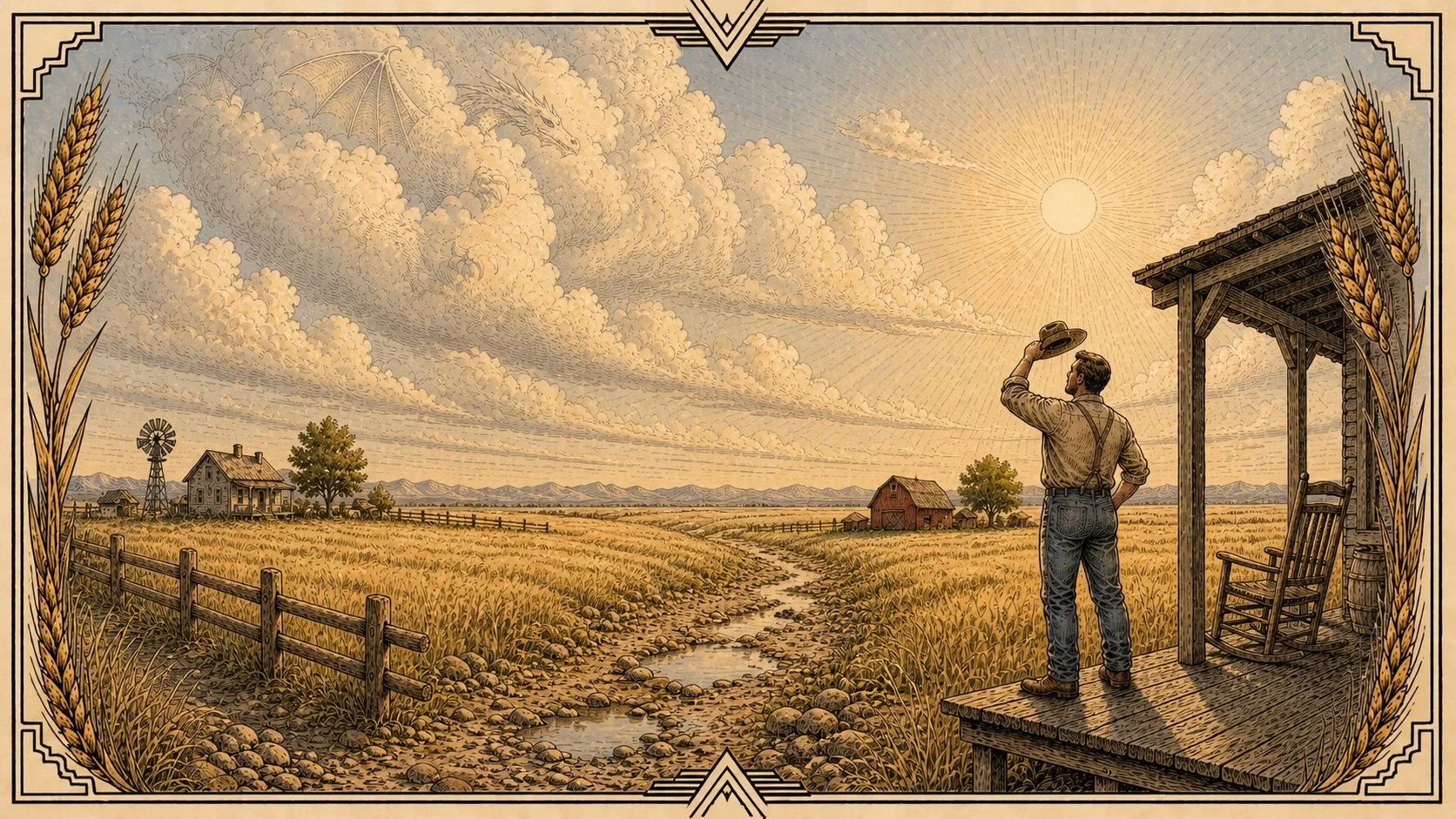
The Weatherdragon Chronicles
Episode 7: When The River Rose
The river had gone narrow enough to show its stones.
That was what everyone said in town, and it was true. The broad, useful current that ought by then to have been moving brown and full between its banks had instead drawn inward upon itself like a patient creature gone thin with waiting. Sandbars showed where no sandbars should show in that part of the year. The willow roots near the bend stood exposed, pale and fibrous in the sun. Even the frogs at dusk had grown quieter, as if unwilling to spend more voice than was needed.
The farmer stood on the bank at first light, looking down into the muddy water.
It moved, but without vigour. A river can be low and still carry purpose. This one seemed tired. It slipped between the stones with a diminished sound, no stronger than a whispering breeze. The cattle had already worn narrow tracks to the best drinking places, and the mud at the shore had dried and cracked into fine scales. Dragonflies flickered above the shallows, bright as pins.
Above the valley, the sky was wide and blue.
No dragon crossed it.
That, too, he noticed.
Most mornings, if he looked long enough, he could find some motion that was more than wind. The Weatherdragon in the higher burdened blue, or Evenfall gliding in evening indigo, or one of the younger pair at work with thaw or snow or light corrective weather over field and road. But the morning above the river was empty in a way that carried its own pressure. The absence of weather had become a weather of its own.
Behind him, his son threw a stone toward the shallows and was disappointed by the sound it made.
“It ought to splash more,” the boy said.
“It ought to.”
The boy squinted downstream. “Will it rain?”
“Not from wanting it.”
The child accepted this only halfway. Children always believe some things ought to happen simply because they are needed. The farmer had once believed that, too. Perhaps he still did, in certain corners of his own mind, he trusted less.
They walked back toward the wagon, where two empty barrels waited. The river still gave enough for household use if one drew carefully and did not waste. Enough for now had become the phrase spoken all over the valley in voices trying not to sound anxious.
Enough for now in the root cellar or the feed bin.
Enough for now in the creek.
His wife said it over the wash basin. The storekeeper said it while measuring flour. So did the pastor, after prayer.
Still, the fields knew the difference.
The corn stood unevenly, and the kitchen garden had begun to hold itself differently, leaves getting smaller and more guarded against the sun.
The pasture grass carried a dusty cast, and the fence posts leaned where the earth around them had tightened and shrunk.
The farmer had seen dry spells before. A dry spell was part of the order of things, when kept within proportion. But this one had begun to stretch beyond comfort and into strain, and, if prolonged, strain altered people before they admitted it.
At breakfast, his wife set out the biscuits and looked from one child to another as they reached for the preserves.
“Only a little,” she said.
The younger boy stopped with the spoon midway. “Why?”
“Because a little is enough for now.”
He frowned, not at the command but at the mood behind it. Children know when thrift comes from wisdom and when it comes from pressure. This came from both.
The older daughter quietly took less without being told. The son, seeing that, did the same.
The farmer watched them and thought about how a dry season worked first on habit, then on tone. No one was yet desperate. No one was hungry. But everyone had begun measuring.
After breakfast, he drove to town with two sacks of grain to trade and a question on his mind that he could not fully form. He wanted news of upstream conditions. He wanted to hear whether the higher country had taken any rain. He wanted, if he was honest, to stand among other men speaking practically about the weather so that his own concern might feel shared and not merely private.
The town carried the dryness in its own visible ways.
Dust lifted from the road and hung longer than it should.
The trough by the livery had been filled only halfway.
The blacksmith’s shirt stuck to his shoulders before noon.
At the store, men spoke in the front shade and kept looking southward between sentences as though clouds might have arrived while they were looking away.
The storekeeper weighed the grain, made his notes, and said, “River’s lower above the crossing than I’ve seen in years.”
“Any rain in the hills?”
“None worth speaking of.” He slid the measure aside. “People keep saying we need a good soaker. As if naming the right kind would bring it.”
At the far barrel of nails, old Mrs. Hale, who missed little in town, said, “It will come when it comes.”
No one contradicted her because age allows certainty in places where younger people would call it mere repetition. Yet her words did not ease the room. They only settled it.
Outside the store, the neighbour Eli Turner leaned against the post and tipped his hat back. “My west pasture’s already being chewed shorter than I’d like.”
The farmer nodded. “Same with the south end here.”
Eli crossed one boot over the other. “Preacher says worry won’t fill a cloud.”
“No.”
“But worry does keep a man busy looking.”
The farmer might have answered, but at that instant the mule hitched at the trough lifted its head sharply and snorted toward the south.
Two dogs in the shade pricked their ears while a horse stamped, and the chickens by the alley fence went still.
The farmer looked up.
Far off in the sky, farther than the Weatherdragon usually worked when attending their valley, something moved in the lower southern distance. Not over the prairie exactly. Beyond it. Beyond the low timber and the bends of the river country, where the land thickened into a darker belt of forest, many days’ travel away.
At first, he thought it was only heat mist or cloud developing at an unusual angle.
Then it gathered shape.
It looked green.
Not the green of field or leaf, but a deep living green threaded with wet bronze and shadowed gold, the colour of heavy foliage after a long rain. The figure moving within the southern haze was long-bodied and immense, with broad wings that seemed made of both cloud and layered leaves. Water trailed from the curves of her as if the air around her had forgotten dryness in her presence.
Monsera.
The farmer had never seen her before, but knew her at once.
She was unlike the prairie family, not in kind but in atmosphere. The Weatherdragon belonged to a force held within a storm. Evenfall to calm precision and healing proportion. Chinook to release and change. Flurry to lightness learning measure. But Monsera carried abundance, not careless abundance, not flood for its own sake, but the lush promise of stored rain and green relief. She seemed older than any single field and nearer to forests than open sky. To look upon her from the dry town street was like smelling wet earth while standing in the dust.
The farmer forgot for a moment that no one else could see.
Eli followed his gaze into the bare blue southward and found nothing. “You hear something?”
“No,” said the farmer slowly. “Only… I think weather is farther away than we hoped.”
That, at least, no one could dispute.
By afternoon, the house had turned quiet with the heat. Even speech seemed to dry in people’s throats. His wife set a basin under the eaves to catch the smallest chance of evening dew, though both of them knew it would hardly amount to enough to water a turnip. The children were told not to run the pump for play. The old mare was brought to the nearer shade because the far pasture had become too open and the trough too hard to fill.
At sunset, the farmer went again to the river.
The valley kept its own hush under drought. Birds called less often, and the grasshoppers seemed louder. The sky took on a pale brass cast at the horizon. Along the shallows, the river slid past with that same diminished, unwilling tone.
He stood on the bank, hat in hand, and waited without quite knowing what he was waiting for.
Then, the air changed.
Not cooler.
Not wetter.
Somehow, fuller.
The dry evening had held itself thin all day, as though every breath drawn from it cost effort. Now that thinness eased. The valley did not green at once or darken with storm. But the emptiness overhead took on depth, like a room when someone enters silently.
Monsera came over the southern timber.
She did not arrive like the Weatherdragon. There was no austere command in her passage, no stern shaping of force. She moved with immense patience, trailing a layered cloud the colour of rain seen through leaves. Her scales glimmered in greens so deep they shaded almost black where the light did not catch them. Along her sides ran marks like flowing water through dense growth. Moss and fern were not truly part of her, yet she called them to mind at once. The edges of her wings shed a fine mist that vanished before reaching the ground.
The farmer drew one slow breath.
She was beautiful in a way the prairie did not usually teach. Not open. Not spare. Rich. Enclosed. Full of hidden springs and shaded roots and long gathering.
She passed above the river bend and looked down—not at him, but at the valley itself.
The low banks and the exposed stones.
Then the fields beyond, with the dry pasture, the thinning current, and the small human places arranged along need.
Then another unmistakable shape joined her from the west, dark blue against the evening brass.
The Weatherdragon.
He approached with the grave steadiness the farmer knew well, but even he seemed different in Monsera’s company, not softened exactly, but broadened, as a mountain storm might look beside a sea. He flew a little above her and to one side, not in command and not in submission, but with the mutual regard of those whose labours meet where climates overlap.
The farmer stepped back under the cottonwood shadow and listened.
Their voices were not heard in the ear. They entered the inward place where dragon speech carried weather as meaning—weight before syllable, direction before word. He caught the shape of it rather than every sound.
“The valley asks,” the Weatherdragon said.
Monsera lowered one great green wing over the river bend, and a thread of cool air passed under it. “It asks as many valleys ask. For relief.”
The Weatherdragon’s gaze remained on the low water. “Will you give it?”
Monsera was silent long enough that the question became an instruction in itself.
“At once?” she said at last. “Or rightly?”
The farmer felt that in his own chest.
All week, he had wanted rain the way dry roots wanted it, now, and enough to feel safe. Yet the fields, the riverbanks, the roads, the stores of earth below the surface, all had their own capacities. Too much on hardened ground would run where it should soak and then flood while breaking away the dry and brittle before it had a chance to drink.
The Weatherdragon’s markings stirred faintly along his sides. “They are near strain.”
“Yes,” Monsera said, “not yet beyond it.”
“Children carry pails farther.”
“Then the women use less.” Monsera said.
“Men watch the sky and call it practicality.”
If a dragon could speak with dry humour, the Weatherdragon had nearly done so. The farmer felt, despite the seriousness of the hour, the smallest inward shift of understanding.
Monsera’s long body curved over the river. “Need does not decide proportion by itself.”
“No,” the Weatherdragon answered. “But delay teaches fear if prolonged.”
At that, Monsera turned her great head and looked directly at the farmer.
He had the strange, humbling sense that she had known of him from the first. Not merely that she saw a man on the bank, but that she recognized him as the witness in this valley, the one who watched the weather in two meanings and carried that burden in silence.
Her eyes were deep bronze-green, bright with distances he had never travelled. Forest rain seemed to live in them. So did floodplain caution, monsoon patience, and the memory of roots drinking in darkness.
“What does your river want?” she asked.
The farmer did not answer at once, not because he was afraid, but because the question deserved more than the first thing that came to mind, and it was more of a feeling sent his way.
At length, he said, “To rise.”
Monsera’s gaze did not change. “And what does it need?”
He looked down at the narrow current moving between exposed stones. He thought of the children measuring preserves. His wife setting a basin for dew. Men in town pretending not to count inches at the trough. Eli watching his west pasture vanish from the top down. The doctor speaking of weak stock. The whole valley feeling itself reduced.
“Enough to hold life,” he said quietly. “Not so much that it tears the banks for answering late.”
Monsera regarded him a moment longer.
Then Evenfall appeared, gliding in on the evening’s first deepening violet, serene and luminous as if dusk itself had taken form. She came beneath the Weatherdragon and above Monsera, a bridge of temperament between them. Her presence did not alter the question. It clarified it.
“Long thirst makes people mistake abundance for healing.”
Monsera inclined her head. “Yes.”
The farmer thought then of children after fasting days, of calves let too long from trough water, of men after harsh words, all of them capable of taking too much too fast when relief finally came. Need did not make proportion easier. It made it more difficult and more necessary.
From the western edge of the sky came another motion, quick and warm: Chinook, bright and young, circling at a careful distance as if drawn by curiosity to this southern presence she did not yet fully understand. She passed above the dry fields, trailing a softer current than the day had known, and looked down at the valley with visible pity.
“Why not fill it?” she asked. “The ground is empty.”
Monsera answered her gently. “Empty things split when they are filled too quickly.”
Chinook slowed.
Below them, the river moved in its reduced channel, patient because it had no choice.
The first rain came that night, and it was almost nothing.
A few drops on the porch rail.
A scatter on the roof.
The faint smell of wet dust rising and then gone again.
The children ran to the door and were disappointed before they all arrived. The younger boy put out his hand, caught two drops, and declared it unfair. His mother sent him to bed anyway.
The farmer stood under the porch and saw why.
Monsera moved high above the valley, not releasing rain in earnest but tasting the air, setting paths, testing how the cooler current from the south met the dry heat held low over the prairie. Evenfall moved with her, refining, smoothing, preventing sharp edges where two weather minds touched. The Weatherdragon remained in the north, bearing pressure and keeping stronger storm-forces from descending before the valley could receive what it needed rightly.
It was work.
Not withholding for cruelty.
Work.
The second day stayed overcast but gave little more rain.
People grew sharper under the delay.
At dinner, the son asked twice for more water before remembering to check himself. The older daughter snapped at the younger one for spilling a cup, then looked ashamed. In town, the storekeeper and the blacksmith argued over whether a wagon wheel ought to be soaked now or saved until later, and both knew the wheel was not the true subject.
Even the pastor, visiting an older widow with a failing water barrel, spoke too quickly to comfort, then slowed his pace and began again.
The farmer saw it everywhere. Long thirst did not merely dry fields. It thinned patience.
That evening, his wife sat on the porch steps with the mending in her lap and said, “People become smaller when they begin counting every drop.”
He sat beside her. “Sometimes counting is wisdom.”
“Yes,” she said. “But fear counts differently.”
The light faded. No one spoke for a while.
Then she added, “The children think rain would solve everything.”
“It would solve some things.”
She nodded. “Enough to make them overtrust it.”
He turned and looked at her. She had said, without seeing the dragons, almost exactly what the sky had been teaching him.
On the third day, the clouds deepened.
Not black.
Not violent.
Layered.
The morning began dim and cool enough that the cattle breathed easier. The hens came farther from the coop, and the dog slept with his nose uncovered. At the river, the exposed stones were still there, but the air above them held scent at last, a green scent, distant and clean, as if leaves were being crushed somewhere beyond sight.
Monsera filled the southern sky.
She moved lower now over the valley, and with her came cloudbanks unlike the prairie’s usual storm build. These were thick and full-bodied, gathered in long folds that suggested rain had been stored within them for a very long time. Their undersides were green-gray. Their edges carried silver where the hidden sun touched them. The whole valley darkened, not with threat, but with expectancy.
The Weatherdragon held back to the northwest, immense and disciplined, preventing the meeting of systems from becoming severe. Evenfall worked between them. Chinook traced the drier upper air, loosening what must loosen. The farmer saw no sign of Flurry; perhaps this was weather too mature and regionally strange for him, or perhaps he had been sent elsewhere. It seemed right that youth should be absent from so measured a labour.
Monsera descended over the river bend and spoke once more to the farmer.
“What have your people learned in waiting?”
He thought of the smaller spoonfuls of preserves. Of the men in town, watching one another more than usual. Of children seeing tension and offering quiet obedience where noise would once have reigned. Of his wife saving dishwater for the garden without being asked. Of the widow who had begun sharing what little well-water she had with a neighbour whose barrel leaked worse than hers.
“That need makes us reveal ourselves,” he said.
Monsera’s great wings moved once, stirring cool air down the valley. “And what have they revealed?”
“Fear,” he said first.
Then, because truth asked more, he went on. “And kindness. Both.”
Evenfall glided past overhead. “Relief is best given where care has not died.”
At that, Monsera opened the rain.
Not all at once.
The first true fall came steady and vertical, a soft gray curtain crossing the river without wind enough to drive it sideways. It struck the dry banks and did not run off in panic. It darkened the soil. It pattered in the willow roots. It pooled gently between stones. The smell that rose from the valley was so rich the farmer nearly laughed from the sheer bodily relief of it.
Rain on thirsty ground smells like mercy when mercy arrives rightly.
He stood and let it soak his hat brim and shoulders.
Across the field, his children shouted from the porch and were allowed, after a token warning from their mother, to run into it. They splashed through the yard with faces tipped upward.
The rain continued through noon.
Not hard enough to scour.
Not sparse enough to tease.
Monsera flew the valley in patient passes, laying moisture where it would soak best. Evenfall cooled and shaped the edges, preserving calm. Chinook worked the higher bands, releasing the last stubborn pockets of dry air. The Weatherdragon remained beyond, bearing a larger force away from them so that the rain stayed gentle and did not become an assault.
By evening, the river had changed sound.
That was the first proof.
Its voice against the bank had strengthened. Not to flood, not even to fullness, but to intention. Water had begun returning to itself. The shallows took on movement. Small runs from the side gullies fed back in. Mud softened underfoot. Frogs began again in earnest.
At supper, the children were almost unbearable with happiness. The younger boy wanted to know if the river would be deep by morning. The older daughter, more sensible, asked whether the lower beans should be staked if the ground softened too much. The son announced that Eli Turner’s west pasture would turn green exactly three days from then, a prediction no one trusted, though all found it cheering.
His wife set extra water on the table without remark.
The farmer noticed.
So did she.
Neither had to speak.
That night, the rain deepened.
The farmer woke to it on the roof, heavier than before.
Not violent, but insistent.
He rose, went to the window, and saw the yard turn silver under a dense fall. The lane had begun to shine. Water ran from the eaves in proper streams. In the south, through darkness and rain, Monsera’s shape moved broad and green-black, like a forest in motion.
Too much? he wondered.
The thought came not from ingratitude but from the valley’s vulnerability. Dry ground that has begun to soften can still be overwhelmed. Banks that welcome rise can be torn by haste.
At dawn, he rode to the river.
It had risen—but not wildly. The exposed stones were mostly gone. The current touched the willows’ lower roots again. Brown water rolled where it had slipped yesterday. The banks held. Grass along the edge bent and drank.
Monsera hovered above the bend, watchful. The Weatherdragon had come nearer, his dark blue form immense against a lighter western break. Evenfall moved between them, calm as ever.
The farmer looked from the strengthening river to the sky and understood the labour still underway. Rain was easy to ask for in ignorance. Harder to lay rightly once the asking became an answer.
Monsera turned one bronze-green eye toward him. “Does it rise well?”
He studied the current.
“It rises enough,” he said.
That seemed a small sentence for so much relief, yet it was the right one.
Enough.
Not because he feared abundance now that it had come.
Because the river’s sound had told him something he had no name for yet.
Monsera inclined her head.
Then the Weatherdragon spoke, his voice deep as a distant storm over hills.
“Many ask for mercy as though mercy were abundance.”
The farmer kept his eyes on the river. “And it is not?”
The Weatherdragon’s markings stirred faintly in the rainlight. “Mercy is often proportion.”
By noon, the rain had softened again.
By evening, it was over.
The valley did not look transformed in theatrical fashion. The fields were not suddenly lush. The river had not become a roaring force. But the earth was darkened through. The pasture breathed a little. Leaves in the kitchen garden lifted. The stock drank and stood more easily. The whole place had moved from strain back toward endurance.
And the people?
The people changed as well.
In town the next day, voices sounded less brittle. The storekeeper laughed once at something not particularly funny. Eli Turner admitted, without anyone drawing it out, that he had watched the first rain from his porch like a child at a fair. Mrs. Hale said only, “There now,” and that sufficed. At church, the hymn carried more fully than it had the previous Sunday.
The farmer walked after service to the river crossing and stood a moment where the water moved strongly enough to command attention again. Along the bank, children from three families were poking sticks into the softened mud and getting their shoes ruined while mothers called half-hearted warnings they did not mean seriously. A pair of boys tried floating bark as a boat. Even the men standing nearby, speaking of planting and timing and whether this rain would be enough to restore the lower fields, had lost that dry, inward set around the mouth.
Relief had not solved everything.
But it had loosened fear’s grip enough for generosity to breathe again.
That evening, when the house had quieted and the children were in bed, the farmer and his wife sat on the porch watching the last wet light fade from the yard.
The basin she had once placed for dew now stood full from rainwater beside the steps.
She nodded toward it. “Strange how precious a little seems before enough comes.”
“Yes.”
“And once enough comes,” she said, “people are tempted to forget they were afraid.”
He rested his arms on his knees. “Is that forgetting?”
“Sometimes.” She threaded the needle through the cloth in her lap. “You can tell by how quickly they stop mentioning it.”
He smiled faintly. “You would have understood the sky this week.”
She glanced at him. “I understood the kitchen.”
“In this house, that is often the deeper thing.”
She accepted this, not as praise exactly, but as fact and perhaps a little humour.
For a while, they listened to the river in the distance, stronger now, carrying its own body properly through the valley. The sound had become part of the evening again.
Above the dark southern horizon, Monsera made one final pass before turning back toward the forest country from which she had come. She looked immense and patient even in departure, trailing the memory of green abundance behind her. To the north, the Weatherdragon turned with her, withdrawing the last of the storm-hold, and the prairie sky settled back into its own weather.
The farmer watched until Monsera was gone.
Then he said quietly, almost to himself, “The river wanted more than it could safely hold.”
His wife, who had not seen the dragon and yet heard something true in the sentence, answered without surprise.
“So do people.”
He turned and looked at her.
She kept sewing. “The hard thing isn’t only wanting relief,” she said. “It’s receiving it without losing sense.”
The river moved in the dark below, no longer starved, not overfull, only alive in proper measure.
The farmer sat with that.
All over the valley, people would say in the days ahead that the rain had come just in time. They would speak of clouds from the south, of good luck in the banks holding, of how wise it had been not to panic and how nearly they had done exactly that. They would fill barrels and reset planting plans and feel themselves returned to ordinary life with grateful speed.
Only the farmer would remember the sound the river made on the third morning—how it had changed before any of them said so.
Not flood. Not theatre. Rain that came the way a good thing arrives when it has been rightly prepared—quietly, and in its own time.
And because the rain had come rightly, the river did what all living things do when relief is given in wisdom.
It rose.