The Thawing Daughter
A late winter freeze has held the valley too long. Frost remains beautiful, but beauty has begun to burden the farm. In this episode, Chinook learns the difference between warming everything and thawing only what needs release, while Flurry discovers that even cold has work to do.
Evenfall had not moved in three days.
Below her, the valley held its breath.
Morning rose clear and hard over the prairie. Winter light sharpened each fence wire. Hoofprints in the yard looked cut from iron. Frost silvered the world with a beauty too fine for comfort. Smoke from the farmer’s chimney climbed straight, then drifted, as though air appeared too rigid to yield.
Below Evenfall, the valley pooled with stillness.
No snow came with this cold, only an unrelenting freeze. Cattle paths became furrows. Creek edges wore clear armour. By noon, the road through town would be ruts and brittle mud, each wheel mark locked in ice.
Beautiful, yes. Clean-lined, glittering, severe.
But beauty that now cut like a burden.
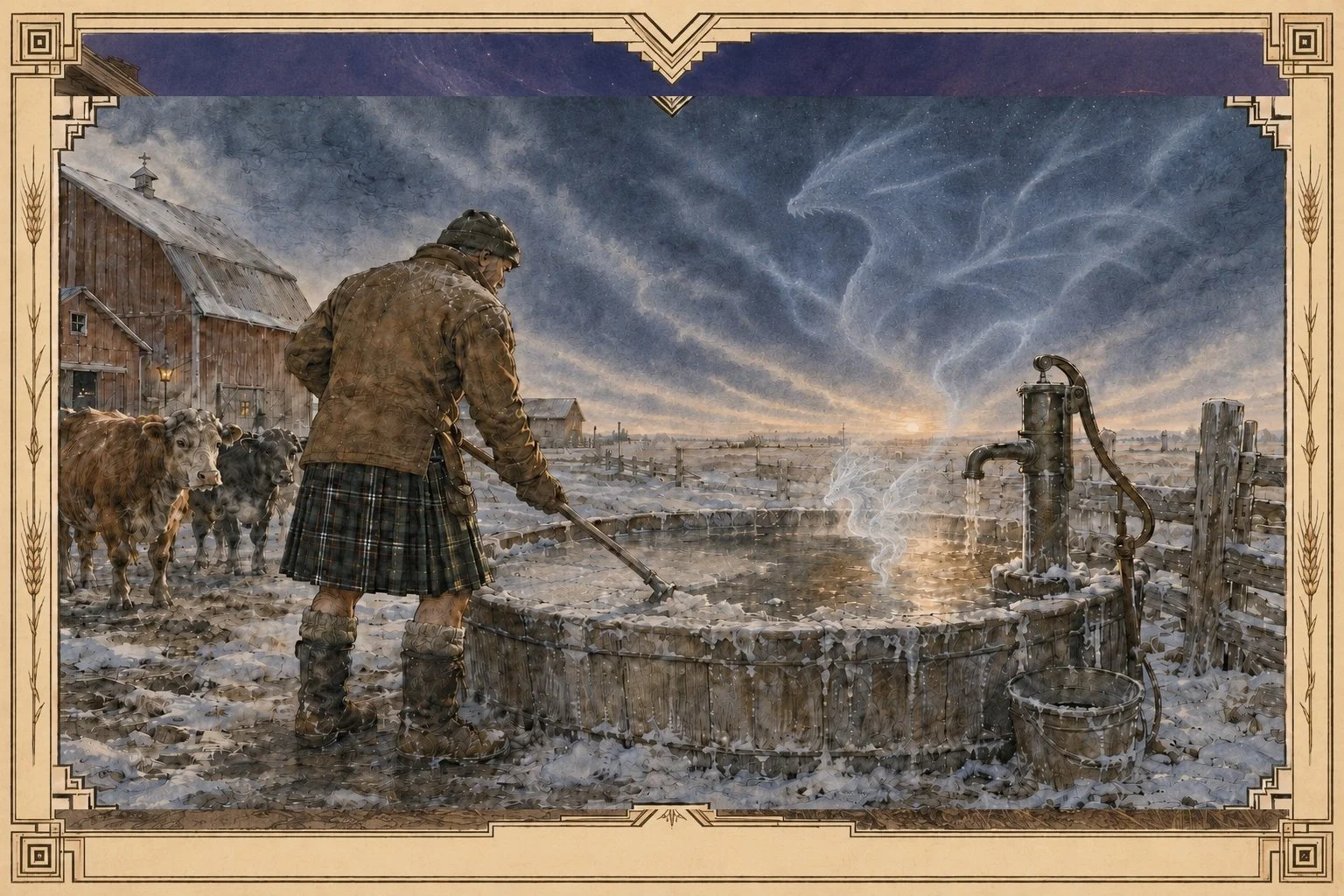
Below, the farmer came out of the barn carrying an axe.
His breath trailed white behind him. Frost gathered at his coat seams and along the bend of his hat. Boots clunked against frozen ground.
At the stock tank, he paused and tested the ice with the axe handle.
It answered with a hollow knock.
He nodded once, not surprised, and raised the axe.
The first blow rang across the morning with a dull thud.
Only then did Flurry flash over snowy field margins and the creek, scattering frost from reeds and fence posts with his wing tips. Wherever he went, the cold seemed to brighten. Sunlight on his scales and ice on the land answered each other, making him blend into the season, a silver streak where the prairie laughed.
He skimmed low over the pump house roof. Frost scattered as his wings touched the surface, leaving a trail of sparkling powder.
“Look at it,” he called. “It sings.”
Chinook, flying lower over the pasture, did not answer at once.
Cold changed her flight. In warmth, she moved with broad, flowing grace. In this freeze, she flew with restrained attention, feeling where the breeze tightened and the land strained. She flew over the stock tank and saw ice thickening in the center, over the barn roof where frost would later send snow sliding, and field margins rimmed in white.
“It sings because it is stretched,” she said at last.
Flurry rolled onto his back beneath a cottonwood limb crusted in frost.
“That makes no sense.”
“Listen longer.”
He didn’t.
Evenfall had been listening for days.
The freeze began as needed for the new season, giving prairie winter its character—driving insects down, quieting rot, signalling seeds to rest soon.
But this cold snap had outstayed its welcome. That was the trouble with weather born from too much delight. It forgot proportion.
He had been feeding it: a sharper glitter before dawn, a harder skin on troughs, a more brilliant edge beneath night stars.
Of course, none of it seemed important taken one at a time.
But together, over days, it became a frozen grip.
The farmer chopped twice more. He drove the blade through and levered up a slab of ice thick as a fence board. Dark water moved beneath.
A red heifer bawled impatiently from the lot.
He widened the opening while the cattle closed in.
Chinook angled lower. “He has been doing that every morning,” she said.
Flurry held his course without turning. “Then he knows how.”
“That is not the point,” she said.
Flurry swept again over the creek where frost made the grasses look dipped in glass. When his wake brushed them, they chimed faintly, thin crystalline sounds like cups touched together.
“That is the point to them.”
Evenfall descended slightly. “And what point is that?”
“That the world can be made more beautiful if no one keeps interrupting.”
The words were young enough to be almost innocent.
Chinook watched the farmyard.
The farmer moved to the pump. He worked the handle; it resisted, then jerked. Only a short cough of water came before the mechanism froze again.
He stripped off a glove and touched the iron.
Even from above, Chinook saw him jerk his hand back.
Frozen.
He stood still for a moment, considering what the morning had become.
Flurry circled overhead, oblivious.
“The sun will fix it.”
“Not soon enough,” Chinook said.
“Humans are always busy with something.”
Evenfall said nothing.
She waited for him to hear what the cold drew from the land: restless hooves, a stiff pump handle, water muttering under the creek ice, and a man working harder because every task took twice the effort.
Unconcerned, Flurry remained delighted with the glittering world.
He swept upward again, chasing his own pale shadow across the field.
Chinook loved beauty too, but not for its own sake.
Frost at daybreak was beautiful. A clean rim of ice along the creek was beautiful. Snow settling quietly over a resting field was beautiful.
But a frozen trough, a stalled pump, and hardened ruts that sprained ankles, these were beauty turned to burden.
Below, the farmer returned from the house, carrying a steaming kettle.
He poured the water slowly over the pump head. Frost hissed. Ice split. When he worked the handle again, water rushed rough and then steadied. He filled the bucket and hauled it back to the tank.
Cattle pushed forward eagerly.
Flurry watched with interest.
“It yields,” Flurry said. “When it must.”
Chinook turned to him.
“You have been feeding the freeze.”
“Only a little.”
“For three mornings.”
He delayed a moment. “Perhaps.”
“Four,” Evenfall said.
Flurry drew one foreleg against his chest and was silent.
“I did not mean harm.”
At that moment, the barn door opened, and the farmer backed out carrying a small brindled calf.
Its legs dangled stiffly. Frost showed at the corners of its nose.
He set it down in a patch of sun and rubbed hard at its sides through a blanket.
Flurry descended just enough to see.
The calf’s mother paced and lowed inside the lot.
“He is not dying,” Evenfall said.
Flurry shot her a hopeful look.
“I did not say he was.”
“But you thought it.”
Chinook hovered low over the yard.
“He was born last night.”
“How do you know?”
She answered, “Because the blood is dark on the straw, and the mother is calling in that tone.”
Flurry listened again, trying to hear it.
The calf shivered.
“I only wanted the frost to stay bright,” he murmured.
Evenfall glided closer.
“And it did.”
“That is not fair.”
“No,” she said. “It is a consequence.”
Chinook watched the yard below.
“Enough,” she said.
“You would melt it all?” Flurry asked.
“No.”
She looked east across the valley.
She drew a slow breath.
Evenfall watched her daughter closely.
Chinook glided low across the pasture, blowing warmth, not harsh heat but the kind that loosens.
The stock tank came first.
The farmer had already broken the center ice. Chinook breathed warmth across the edges. The pale plate softened and fractured outward in quiet fans.
Water widened.
The cattle lifted their heads.
Flurry perched on the fence rail.
“Why not break it?”
“Because the shock would freeze it rougher by sundown.”
“Oh.”
Chinook moved to the pump.
She warmed the iron, slowly, from all sides. Frost slackened. A bead of water formed at the spout.
“It feels like nothing,” Flurry said.
“It is just enough.”
Below them, the farmer paused, noticing the change.
Chinook was already moving on.
She followed the ditch line toward the creek.
Here, the freeze built its most delicate prison. Reeds wore white lace. The creek edge curved under ice like glass laid by careful hands.
Beautiful.
Chinook hovered, letting warmth fall gradually.
First came a dimming beneath the ice. Then thin dark seams. Water remembered itself and pressed upward.
The frozen rim lifted and split into wide, drifting plates that knocked together to slow music.
Flurry stared.
“I thought warm made things rush.”
“Too much warm does.”
“How do you know how much?”
“Listen to what changes.”
“That sounds slow.”
“It is.”
The morning lengthened toward noon.
Here and there, Chinook laid careful warmth upon the valley.
The tank widened. The pump loosened. The creek began speaking again.
None of it was dramatic.
That was the point.
Then the farmer noticed.
He did not look astonished anymore when impossible weather corrected itself around him. Instead, he looked grateful, alert, and careful not to waste the help.
Flurry, meanwhile, had grown restless, feeling useless.
“What can I do?” he asked.
Evenfall let him wait.
“Look where the cold is a burden,” she said, “not where it is beautiful.”
Flurry looked again at the valley.
This time, he saw different things.
The shadow side of the barn where frost never eased. The dog stepping stiffly across frozen ground. The slick path between pump and porch. The calf struggling to stand.
His ears lowered.
“I did all that?”
“Not by yourself,” Evenfall said. “The season worked with you.”
“That does not make it better.”
“No.”
Flurry hovered uncertainly.
“I cannot do what Chinook does.”
“No,” Chinook said calmly. “You cannot.”
He bristled.
“You have different gifts. You can do other things.”
Flurry frowned.
“That sounds like work.”
“It is easier than wisdom,” Evenfall said.
Flurry tried.
His first pass nearly refroze a wet patch, leaving it harder than before.
Chinook gave him a look.
He winced and tried again.
This time, he skimmed the south side of the barn, where Chinook’s warmth had started loosening the frost from the boards. He gathered the freed chill and carried it upward, away from the calf bed and over the field where winter could keep it without harm. The motion was clumsy, but it worked. The next pass he made over the path to the pump, stirring the sun-warmed surface just enough that the ice dulled and sweated instead of glazing again.
The farmer came from the house with another kettle and stopped short when his boot sank half an inch into the softened grime where, a moment before, the path had been glass.
He crouched, touched it, then looked toward the south side of the barn where the boards no longer shone white.
“Well now,” he murmured.
Flurry heard the sound, if not the words.
“That was me,” he said, startled.
“Yes,” Chinook answered.
He made another pass, more careful still.
By noon, the valley had changed character. Not warmed, exactly. Winter remained. Breath still showed. Shade still bit. The distant field margins still held their white glitter. But the freeze no longer gripped every surface with equal authority. Water moved where it should. The pump worked. The path softened under the sun. The calf slept instead of shivering. Cattle could drink without waiting for the chopping of the axe.
The farmer stood by the tank, one mitten on the rim, and took stock of it all.
To anyone else, perhaps, it would have looked like the ordinary work of a late winter morning. The sun gaining a little strength. A man managing chores. Ice easing where it could. But he knew the pattern now. Knew that what his neighbours would call a moderating day had, in fact, a face.
He looked toward the creek bend where the ice had broken into floating panes and moved on the current like little fleets of glass. Higher, over the pasture, Flurry made a tentative sweep, not playing now but working, carrying cold out over the open field where it thinned harmlessly in the bright air. Beyond him, Chinook moved in wider, slower arcs, warming only where needed, never all at once.
And above both, Evenfall watched.
The farmer lifted his hat briefly, though the air yet stung his ears.
Respect, gratitude, acknowledgment. It was difficult to sort these things from one another out here, and perhaps it was unnecessary.
He resettled his hat and went back to his work.
He spent the afternoon mending a gate latch that had frozen stiff three mornings in a row. Then he hauled a load of split wood to the porch. Then he checked the eaves where long, narrow icicles had begun to drip at last. These were small tasks, but each appeared lighter than it should have been, as though the day itself had switched from opposition to cooperation.
Chinook felt it too.
She had enjoyed the freeze at first, if she admitted it. The valley in hard light. The creek in glass. The mornings bright with frost. She understood Flurry’s fascination because some of it lived in her too.
Perhaps that was why she had not stopped him sooner.
That thought troubled her.
She crossed the field edge and followed the lane toward the road, where wagon ruts remained locked under the thin sun. There she laid another measure of heat, enough to soften the upper ridges before evening without turning the road to mire. Behind her, the patterns left by wheels and boots relaxed. Sharp edges slumped. A crow landed and pecked at the exposed dark, satisfied.
Evenfall joined her.
For a time, they flew in silence above the lane.
At length, Chinook said, “I should have acted sooner.”
Evenfall did not answer immediately. The sky had gone pale and high with afternoon, a winter blue so clear it seemed brittle itself. Below, the farmer crossed from the woodpile to the house carrying an armload against his chest.
“What kept you?” Evenfall asked.
Chinook watched the road below her soften by degrees.
“I liked it.”
“The freeze.”
“Yes.”
Chinook waited for blame and received none.
Evenfall’s wings moved once, broad and slow.
“Wisdom does not come from loving only harmless things.”
Chinook looked at her.
“It comes,” Evenfall said, “from recognizing when what you love becomes something it was never meant to be.”
The words rooted in Chinook more deeply than praise would have.
Below them, Flurry was still at work. He had found a strip along the lee of the granary where cold pooled and held longer than the sun could quickly reach it. There he made careful little sweeps, lifting trapped chill and spinning it loose into the open field. The movement had become almost elegant. Not yet natural, perhaps, but earnest enough to approach grace.
Chinook smiled despite herself.
“He is trying very hard not to be himself.”
Evenfall’s mouth curved.
“Perhaps he is trying to be more of himself than he knew he contained.”
Flurry heard neither the words nor the inflection, but something in the air above him softened, and he looked up at once.
By late afternoon, the valley had entered that brief winter mercy when cold still ruled but no longer punished. The tank held open water. The pump handle moved without protest. The creek muttered under broken ice. The path from porch to barn no longer shone deadly underfoot. Frost still embroidered the far fences and the north ditch, and the wheat stubble beyond the harvested field still glittered where shade preserved it.
Beauty remained.
Burden reduced.
The farmer made one final round before dusk.
He checked the calf first and found it standing shakily, legs not yet trustworthy, but getting used to the notion of holding weight. He smiled into his scarf and rubbed its neck. Then he tested the pump and listened with satisfaction to the easy fall of water into the bucket. Then he walked to the creek and stood watching the thin plates drift downstream, catching the daylight like broken mirrors.
At the bend, he stopped and looked up.
Chinook was crossing the sky above him. Not so low as to startle, but near enough that he could make out the warm bronze below her scales where the slanting light struck. She proceeded with a quiet fullness, as though the day had asked much of her and she had given it willingly.
The farmer rested both hands on the top rail of the creek fence.
“You did the lion’s share,” he said in a soft tone.
Chinook heard only the shape of the feeling, but it was enough. She dipped one wing.
The gesture startled him, even now.
Not because it was impossible, he was long past trying to name these things impossible, but because it was personal. A reply. Recognition crosses the distance between species as naturally as a breeze crosses a field.
Flurry, seeing the dip, darted near.
“What was that for?”
Chinook glanced at him.
“Nothing that concerns you.”
That offended him on principle.
“Everything concerns me.”
Evenfall descended into the western air above them, bringing with her the first dimming tint of sundown.
“Not quite,” she said, “but more concerns you now than once did.”
Flurry was too pleased by the compliment hidden in the rebuke to argue.
They turned together toward the pasture as evening began unrolling itself over the prairie. The light thinned from white gold to amber, then into the violet and rose that Evenfall carried so easily with her. Cold would deepen again after sunset, proper cold now, seasonal and useful. But it would not clutch as before. Chinook had seen to that. And Flurry, to his own surprise, had helped.
The farmer returned to the yard with a slower gait than in the morning.
Winter labour always found a man’s joints by day’s end, and the tiredness was in him. But there was also relief, and something more subdued beneath it. He had witnessed once more what no one else seemed to. The Haskells, if asked tomorrow, would remark only that the freeze had finally eased. Someone in town would say the sun had strength in it after all. Another would mention that late winter liked to test a body before relenting. All of that would be true in the way most truths were true, enough to stand, but not enough to reach the roots.
Only he would know that beauty had overstayed itself in the morning and that one dragon, who loved frost perhaps nearly as much as her brother did, had spent the day persuading the cold back into wisdom.
He filled the kettle, set it on the stove, and then came back out to stand by the south wall of the barn where the calf slept in fresh straw. The dog circled twice and flopped near the door. The red heifer chewed in the subdued light. Somewhere overhead, wings passed through the evening.
The farmer looked up.
Against the deepening west, Evenfall rode highest. Below her, Flurry moved in quick loops that kept threatening to become play before he remembered himself and steadied. Beside him, Chinook flew with that same measured warmth that she had carried all afternoon, though now it was gentler, less labour and more experience, maybe the afterglow of care.
He leaned one shoulder against the barn wall and watched until the cold nipped his ears.
“You’ve a good hand for thawing,” he said into the evening.
The words left his mouth in a puff of white.
Above, Chinook slowed.
Evenfall’s gaze moved to her daughter, the unmistakable look of a mother’s pride.
Flurry followed the look, then glanced from mother to sister with the quick understanding of one who notices affection by the shape it leaves in the air.
The farmer, seeing them all turned that way, realized he had intruded somehow into a family current not meant for him. He began to push off the wall, ready to move back into the house and let the sky have its own.
But Evenfall spoke first, her speech moving through the cold like evening itself lying over the land.
“Well done, daughter.”
The words reached Chinook fully, and though the winter air stayed sharp enough to cut, warmth moved through her with such force that for one startled instant she thought she might brighten the whole valley by accident. She lowered her head, not from embarrassment exactly, but from the tenderness of receiving something she had not known all day that she had wanted so badly.
Flurry looked at her, then at their mother, and made an exaggerated face meant to hide that he understood.
“I helped,” he muttered.
Evenfall’s eyes shifted to him.
“You did.”
That was enough to send him skimming sideways in embarrassed relief, though more gently than he would have flown that morning.
The farmer smiled into his scarf.
Something had reached him. Not words exactly. The shape beneath them.
Whether by long exposure or by the dragons’ own choosing, their meanings had begun to settle into him with less resistance. He did not question it anymore. The prairie changed a man’s thresholds. Why should this be different?
He stood a while longer in the blue gold calm of evening, watching them turn west together.
Then he went inside to his stove, kettle, and lamplight while outside the last of the day’s thaw settled into the land. Water moved under the ice. Frost loosened where it should. Beauty remained where it could. And the valley, with the sunrise, had glittered too hard to be kind, now held the gentler balance winter was meant to keep.
In the night, a little new frost came, but not enough to be a burden.
In the early morning, the pump worked on the first try. The stock tank wore only a skin thin enough to break under a bucket rim. The path to the barn held firm without treachery. At the creek, broad panes of yesterday’s loosened ice had drifted into the reeds and flowed into lace. The calf stood with splayed, uncertain legs, but stood all the same, its nose wet, its eyes wide.
The farmer took all this in at a glance and then tilted his head toward the waking sky.
Neighbours would say the freeze had broken.
He knew better.
It had been taught to let go.
Read next
Continue with the next Season 1 episode when available, or return to the Season 1 Weatherdragon stories page.